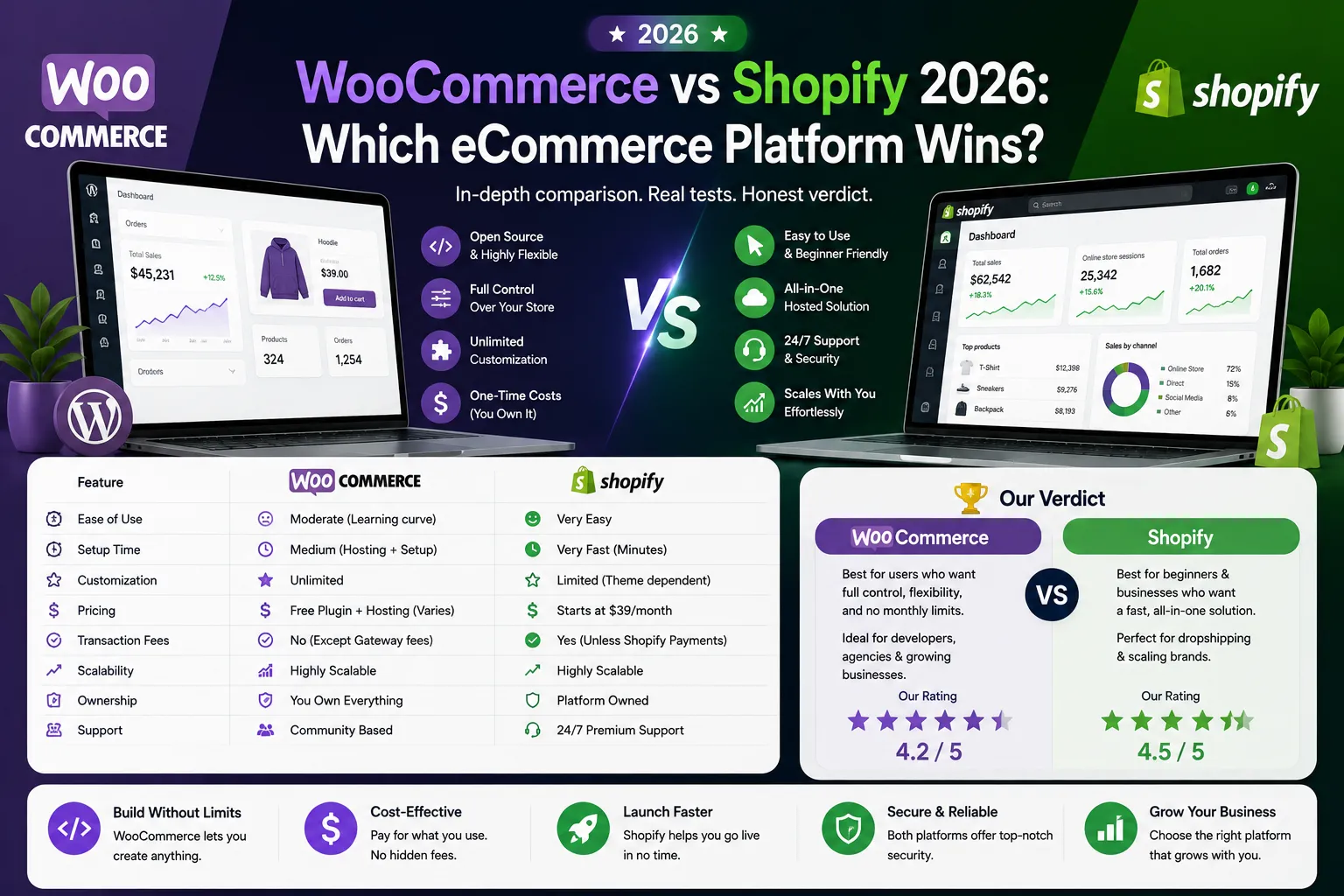
| QUICK VERDICT Best for Beginners: Shopify — zero technical setup, 24/7 support, hosted infrastructure.Best for Control: WooCommerce — free core plugin, 60,000+ plugins, full data ownership. Shopify Basic starts at $39/month (all-in). WooCommerce core is free — but real storecosts reach $50–200/month with hosting, plugins, and themes. Neither platform isobjectively better. The right choice depends entirely on your technical comfort andgrowth ambitions. |
Choosing between WooCommerce vs Shopify is one of the biggest decisions for any online store owner in 2026. This WooCommerce vs Shopify comparison answers exactly that question. We break down both platforms’ pricing, SEO performance, dropshipping capabilities, and real user feedback so you can decide which side of the WooCommerce vs Shopify debate fits your business needs in 2026.
Additionally, 2026 marks a significant year for both platforms. Notably, WooCommerce now powers over 7 million active stores globally — roughly 23% of all eCommerce websites. Shopify, meanwhile, crossed 4.6 million active merchants. Therefore, understanding what makes each platform the right choice — and where each genuinely falls short — is essential before committing.
1. WooCommerce vs Shopify — Quick Overview
The WooCommerce vs Shopify comparison starts with a fundamental difference in architecture. Specifically, WooCommerce is an open-source plugin that runs on WordPress — a self-hosted, fully customizable setup. Shopify, on the other hand, is a fully hosted SaaS platform. Consequently, choosing between them is really choosing between ownership and simplicity.
Furthermore, both platforms dominate eCommerce globally — but for very different audiences. Notably, WooCommerce appeals to developers, agencies, and business owners who want full control over their store’s code, data, and hosting environment. Shopify appeals to entrepreneurs and beginners who want a store running in hours without touching a server.
For a full deep-dive on each platform individually, read our full WooCommerce Review 2026 and our full Shopify Review 2026 before making your final decision. Not sure Shopify’s real monthly cost makes sense for you yet? See is Shopify worth it in 2026 for a quick break-even check.
Side-by-Side Comparison Table
| Feature | WooCommerce | Shopify |
|---|---|---|
| Type | Open-source WordPress plugin | Hosted SaaS platform |
| Base Cost | Free plugin | $39/month (Basic) |
| Hosting | Self-managed (your cost) | Included in plan |
| Ease of Setup | Moderate — needs WordPress | Easy — 30 min setup |
| Plugin Ecosystem | 60,000+ WordPress plugins | 8,000+ Shopify apps |
| Transaction Fees | None (gateway fees only) | 0.5–2% (unless Shopify Payments) |
| SEO Control | Full — unlimited customization | Good — some limitations |
| Support | Community forums (free plugin) | 24/7 live chat & email |
| Best For | Developers, WordPress users | Beginners, fast launchers |
2. WooCommerce vs Shopify Pricing & Fees
While WooCommerce is technically “free” and Shopify is a paid subscription, the real-world cost of running both platforms is surprisingly close. Here is the honest breakdown:
Shopify Costs: Predictable. You pay a fixed monthly fee (starting at $39/month for Basic) which includes hosting, SSL, and security. However, Shopify charges a 0.5% to 2% transaction fee if you don’t use Shopify Payments.
WooCommerce Costs: Variable. The plugin is free, but you must pay for managed hosting ($5–$25/month), a domain, and essential premium extensions (like subscriptions or advanced shipping). On the bright side, WooCommerce charges 0% platform transaction fees.
| Expense | WooCommerce | Shopify |
|---|---|---|
| Platform Fee | Free | $39–$399/month |
| Hosting | $7–80/month (your cost) | Included |
| Domain | $15/year | $15/year (or included) |
| SSL Certificate | Free (via host) | Included |
| Premium Theme | $49–150/year | $180–350 (one-time) |
| Essential Plugins/Apps | $100–500/year | $100–300/year |
| Transaction Fees | None | 0–2% per sale |
| Payment Processing | 2.9% + $0.30 (standard) | 2.9% + $0.30 (standard) |
| Total (typical store) | $50–200/month | $39–150/month |
| 💡 Key Insight: Don’t choose WooCommerce just because it’s “free.” By the time you add premium hosting and essential extensions, your monthly expenses will be similar to Shopify. Choose WooCommerce for fee-free scaling, and Shopify for predictable billing. |
2.1 WooCommerce Payments vs Shopify Payments (The Hidden Cost)
Both platforms have native payment gateways that charge standard credit card processing fees (usually around 2.9% + $0.30)
The Big Difference: If you decide to use a third-party gateway like PayPal or Stripe, Shopify penalizes you with an extra transaction fee. WooCommerce never charges you a penny for using your preferred payment processor.
| 💡 Key insight: The WooCommerce vs Shopify fees comparison favors WooCommerce for high-volumestores (no platform transaction fees) and Shopify for new stores (no surprise costs).Therefore, calculate your projected monthly revenue before choosing — the math is differentat $1,000/month vs $50,000/month. |
3. WooCommerce vs Shopify SEO — Which Ranks Better?
The Verdict: WooCommerce wins for advanced users who want total code control, while Shopify wins for beginners who want automatic, out-of-the-box SEO.
WooCommerce SEO: Gives you 100% access to customize your URL structure, canonical tags, and redirects. You can use powerful WordPress plugins like Yoast SEO or Rank Math for advanced schema. The catch? You are completely responsible for managing your own site speed and hosting optimization.
Shopify SEO: Handles the technical basics (XML sitemaps, clean URLs, SSL certificates) automatically. It runs on a fast, global CDN out of the box, which Google loves. However, deep technical customizations—like removing /products/ from your product links—are highly restricted.
| SEO Factor | WooCommerce | Shopify |
|---|---|---|
| URL Control | Full — any structure | Partial — /products/ forced |
| Meta Tags | Full via Yoast/Rank Math | Built-in editor |
| Schema Markup | Plugin-powered (Rank Math) | Built-in product schema |
| Canonical Tags | Full control | Auto-generated |
| Blog SEO | WordPress — best in class | Built-in blog (limited) |
| Page Speed | Depends on hosting | CDN-powered — fast default |
| Overall SEO Control | ⭐⭐⭐⭐⭐ | ⭐⭐⭐⭐ |
4. WooCommerce vs Shopify Speed & Performance
The Verdict: Shopify wins by default for instant setup, but a well-optimized WooCommerce store can match or beat Shopify’s speed.
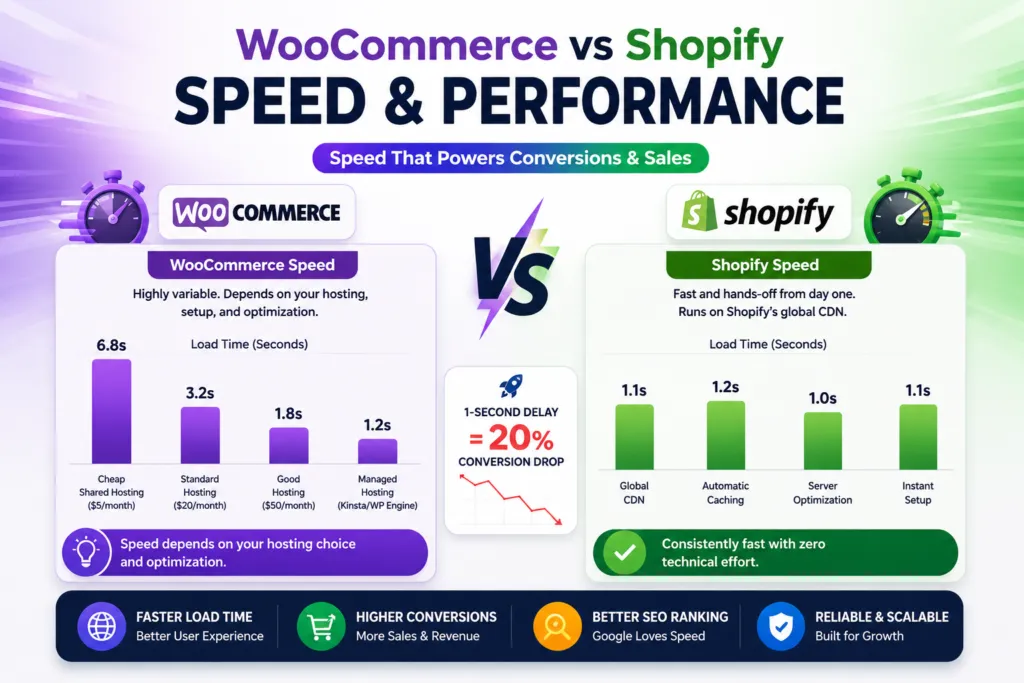
Shopify Speed: Fast and hands-off from day one. Your store runs automatically on Shopify’s global CDN. Caching, server optimization, and infrastructure updates are completely handled for you.
WooCommerce Speed: Highly variable. Because it runs on your own hosting, a cheap $5/month shared server will make your store painfully slow (loading in 4–7 seconds). To match Shopify, you must invest in quality managed hosting like Kinsta or WP Engine.
| Speed Factor | WooCommerce | Shopify |
|---|---|---|
| Default Speed | Depends on hosting | Fast — CDN included |
| With Premium Hosting | Matches Shopify | Already fast |
| Plugin Impact | Each plugin adds load | App-based (better isolation) |
| Image Optimization | Plugin required | Built-in |
| Core Web Vitals | Achievable — requires effort | Good by default |
| 💡 The Revenue Impact: Page speed directly impacts your wallet. According to Google’s research, a mere 1-second delay in page load time can drop your conversions by up to 20%. |
5. WooCommerce vs Shopify for Dropshipping
The Verdict: Shopify wins for beginners who want instant automation, while WooCommerce wins for high-volume dropshippers looking to maximize profit margins.
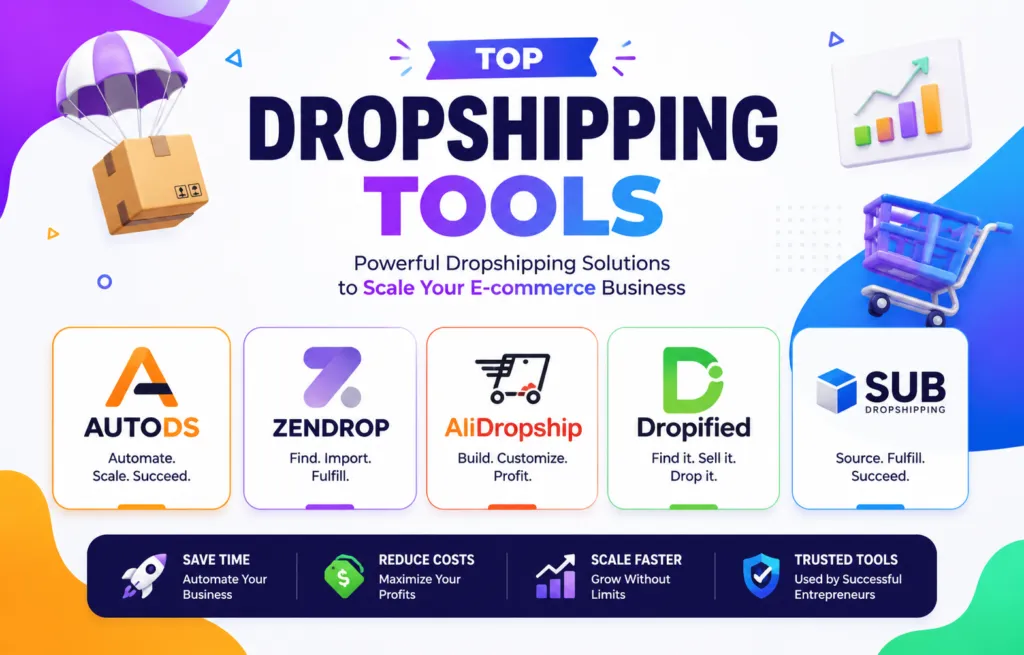
- Shopify Dropshipping: Built for speed. With one-click apps like DSers, AutoDS, and Zendrop, you can source products and automate fulfillment within hours. It’s completely hands-off, making it the default choice for beginners.
- WooCommerce Dropshipping: Built for control. Using plugins like AliDropship or Dropified, you get advanced pricing formulas and custom supplier setups. There are no monthly app subscriptions or platform transaction fees, saving you massive profits as you scale.
💡 The Scaling Pivot: Most dropshippers start on Shopify for ease of use, but migrate to WooCommerce once they cross $10,000/month to avoid Shopify’s transaction fees and app costs.
| Factor | WooCommerce Dropshipping | Shopify Dropshipping |
|---|---|---|
| Top Apps/Plugins | AliDropship, WooDropship | Dsers, AutoDS, Spocket |
| Setup Difficulty | Moderate | Easy |
| Transaction Fees | None | 0.5–2% (without Shopify Payments) |
| Supplier Options | AliExpress, custom CSV | AliExpress, global suppliers |
| Automation Level | High (with plugins) | High (built-in apps) |
| Best Volume | $10,000+/month | Beginner to mid-level |
6. WooCommerce vs Shopify vs BigCommerce vs Magento
The Verdict: Shopify & WooCommerce dominate for small-to-mid stores, BigCommerce is the best transaction-fee-free middle ground, and Magento is strictly for enterprise brands.
BigCommerce: The strongest alternative to Shopify. It charges 0% transaction fees, includes multi-currency natively, and has great built-in features, but its app ecosystem is smaller.
Magento (Adobe Commerce): A heavy, enterprise platform. It requires dedicated developers and costs $50,000+ to build, making it unrealistic for small businesses.
Wix eCommerce: Super easy to set up, but has very weak inventory management and scalability. Best for small hobby stores selling under 50 products.
Quick Verdict Table — Which Platform Wins?
| Feature | WooCommerce | Shopify | BigCommerce | Magento |
|---|---|---|---|---|
| Base Cost | Free + hosting | $39/month | $39/month | Free (self-hosted) / $22k+/yr Adobe |
| Ease of Use | Moderate | Easy | Easy-Moderate | Complex |
| Transaction Fees | None | 0–2% | None | None |
| Plugin/App Count | 60,000+ | 8,000+ | 1,500+ | 5,000+ |
| SEO Control | ⭐⭐⭐⭐⭐ | ⭐⭐⭐⭐ | ⭐⭐⭐⭐ | ⭐⭐⭐⭐⭐ |
| Scalability | ⭐⭐⭐⭐⭐ | ⭐⭐⭐⭐ | ⭐⭐⭐⭐⭐ | ⭐⭐⭐⭐⭐ |
| Support | Community | 24/7 Live | 24/7 Live | Enterprise only |
| Best For | WordPress users | Beginners | Mid-market | Enterprise |
| 💡 Key insight: The WooCommerce vs Shopify vs BigCommerce comparison shows BigCommerce asthe best ‘middle ground’ — no transaction fees, enterprise features, and a managed hostingenvironment. However, its smaller app ecosystem is a real limitation. Therefore, ifWooCommerce feels too technical and Shopify feels too expensive at scale, BigCommerceis the honest third option. |
7. WooCommerce vs Shopify for Small Businesses
The Verdict: Shopify wins for small businesses that want a hands-off, “sell first, learn later” approach, while WooCommerce wins if you already run an established WordPress site.
- The Tech Barrier: Shopify’s onboarding wizard, built-in payment setups, and 24/7 customer support remove all technical hurdles—perfect for a first-time seller in Karachi or Mumbai who wants to go live this week.
- The WordPress Advantage: If you already have a WordPress blog, portfolio, or local business site, adding WooCommerce takes hours, costs nothing upfront, and keeps all your existing content intact.
💡 The Growth Stack: To maximize your small business sales, pair your store with the right backend tools. Check out our guide to the best free CRM for small businesses in 2026 and our deep-dive Brevo Review 2026 to automate your email marketing from day one.
| Business Type | Recommended Platform | Reason |
|---|---|---|
| First-time seller, no tech background | Shopify | Zero-setup, 24/7 support |
| WordPress blog adding a store | WooCommerce | Same ecosystem, no migration |
| Dropshipping beginner | Shopify | App ecosystem, fast setup |
| Dropshipping at scale ($10k+/mo) | WooCommerce | No transaction fees |
| Custom store with complex tax/shipping | WooCommerce | Full plugin flexibility |
| Seller using Instagram/Facebook Shops | Shopify | Native social integrations |
| Developer building client stores | WooCommerce | Open-source, full control |
8. WooCommerce vs Shopify — Pros and Cons
Here is the honest breakdown of the pros and cons of both platforms, based on real user feedback and platform features:
WOOCOMMERCE PROS
- Core plugin is 100% free — unlimited products, orders, and customers at zero platform cost
- Unmatched flexibility — 60,000+ compatible plugins for any imaginable feature
- Full store ownership — you own the data, the code, and the hosting
- No platform transaction fees — only standard payment gateway fees apply
- Open-source and community-supported — 100M+ downloads, active global developer community
- Scales from side-hustle to enterprise — same plugin handles 1 to 50,000+ products
- Deep SEO control — integrate Yoast, Rank Math, or any SEO plugin freely
WOOCOMMERCE CONS
- Steeper learning curve — requires WordPress familiarity to set up properly
- Real cost is not zero — hosting + plugins + themes add up to $50–200+/month
- Technical maintenance responsibility — updates, compatibility, and security are your job
- Customer support is self-service — no live chat for the free plugin, forums only
- Premium extensions are expensive — Subscriptions ($279/yr), Bookings ($249/yr) add up fast
- Plugin conflicts can break checkout — more extensions means more failure points
SHOPIFY PROS
- Easiest setup of any major eCommerce platform — live in under 30 minutes
- 24/7 customer support — live chat and email on every paid plan
- Fully hosted — no servers, updates, or security patches to manage
- Built-in CDN — fast page loads globally without configuration
- Strong social selling integrations — Instagram, Facebook, TikTok Shop built-in
- Shopify Payments eliminates transaction fees for eligible countries
- 8,000+ apps — deep ecosystem for marketing, fulfillment, and analytics
SHOPIFY CONS
- Monthly fees are unavoidable — $39/month minimum even for the smallest store
- Transaction fees on third-party gateways — 0.5–2% per sale on top of processing fees
- Less flexibility than WooCommerce — URL structure and code are partially locked
- App costs add up fast — advanced features require paid apps at $10–50+/month each
- No full data portability — migrating away from Shopify is complex
- Shopify Payments not available in all countries — limits the no-fee advantage
Decision Matrix — Choose by Use Case
| Feature | WooCommerce | Shopify |
|---|---|---|
| Ease of Use | ⭐⭐⭐ | ⭐⭐⭐⭐⭐ |
| Pricing Control | ⭐⭐⭐⭐⭐ | ⭐⭐⭐ |
| SEO Control | ⭐⭐⭐⭐⭐ | ⭐⭐⭐⭐ |
| Speed (default) | ⭐⭐⭐ | ⭐⭐⭐⭐⭐ |
| Dropshipping | ⭐⭐⭐⭐ | ⭐⭐⭐⭐⭐ |
| Plugin Ecosystem | ⭐⭐⭐⭐⭐ | ⭐⭐⭐⭐ |
| Customer Support | ⭐⭐⭐ | ⭐⭐⭐⭐⭐ |
| OVERALL | ⭐⭐⭐⭐ | ⭐⭐⭐⭐ |
| ✅ Choose WooCommerce if: You’re on WordPress already | You want full data ownership | You run high transaction volumes | You need deep customization | You have tech skills ✅ Choose Shopify if: You’re a first-time seller | You want zero maintenance | You sell on Instagram/TikTok | You want 24/7 support | You need fast setup ✅ Best WooCommerce entry point: Free plugin + SiteGround GrowBig ($5.99/month) ✅ Best Shopify entry point: Shopify Basic at $39/month — 3-day free trial available ✅ Best alternative if neither fits: BigCommerce — no transaction fees, managed hosting |
Building your full small business stack? Our guide to the best productivity tools for small businesses covers the complete toolkit that complements your eCommerce store.