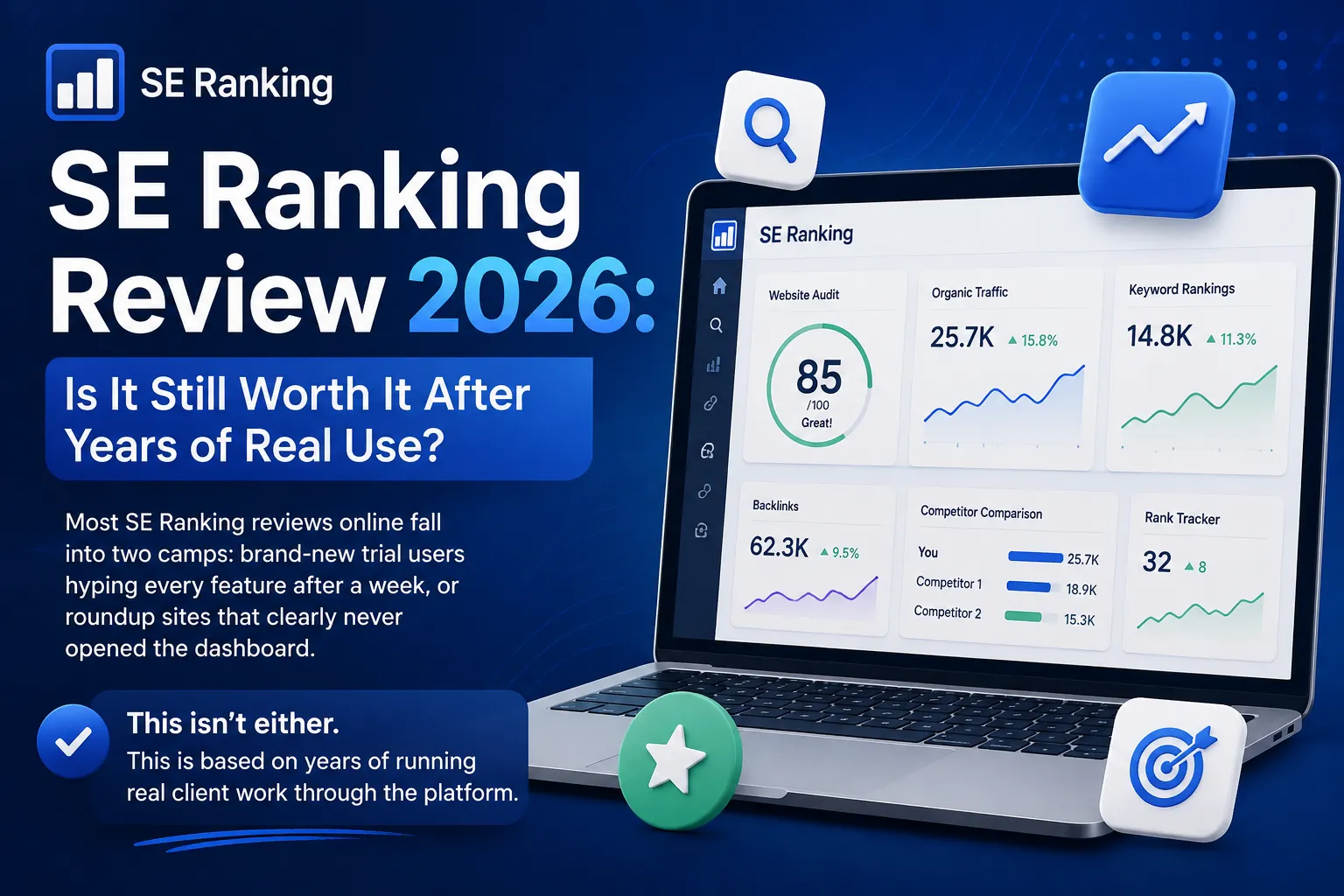
We’ve used SE Ranking as a paid, day-to-day SEO platform for a long time — through several redesigns, feature launches and, most recently, its 2026 pricing overhaul. This review is written from that ongoing hands-on use, and every price, plan limit and feature claim here was re-verified against SE Ranking’s official pages in August 2026, because a lot of what you’ll read elsewhere still quotes plans that no longer exist. Where we’re describing something we personally use, we say so (“in our experience”, “what we found”). Where a claim comes from documentation or third-party data rather than our own testing — backlink index size, for example — we flag that instead of pretending we benchmarked it.
The short version: SE Ranking is one of the best-value all-in-one SEO platforms in 2026, especially if you want to run rank tracking, site audits, keyword and competitor research, and client reporting from a single workspace. It isn’t the deepest tool in any single category, and its headline price hides some real cost multipliers. This review will help you decide whether that trade-off is right for your situation.
What Is SE Ranking?
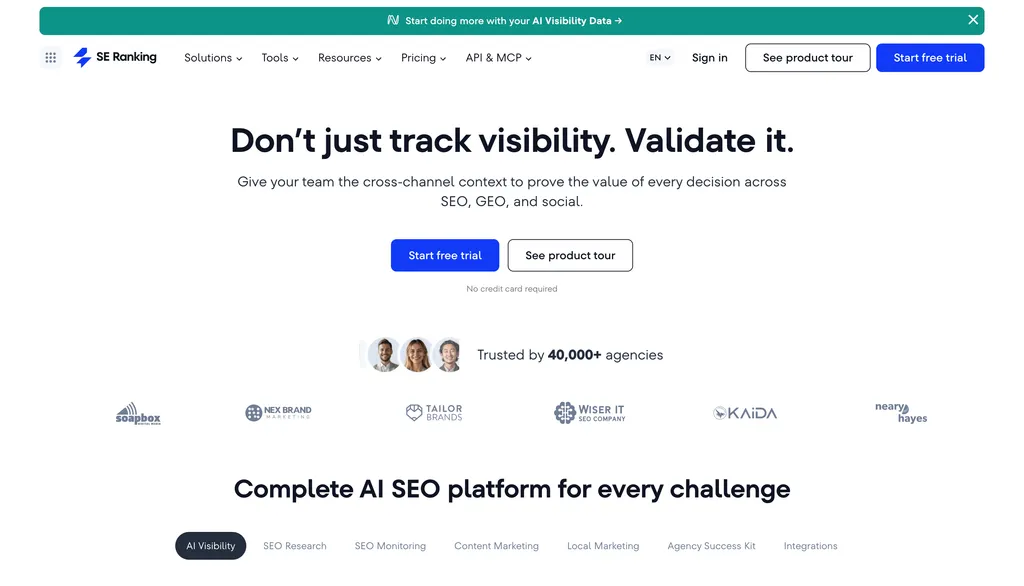
SE Ranking is a web-based, all-in-one SEO platform that brings rank tracking, keyword research, competitor analysis, website audits, backlink monitoring, on-page tools, local SEO, reporting and — as of 2026 — AI search visibility into one dashboard. The idea is consolidation: instead of paying for a rank tracker, a separate audit tool, a keyword tool and a reporting layer, you run most of your recurring SEO work from a single project-based workspace.
The company has been around since 2013, and the platform is widely used by freelancers, in-house marketers, content teams and — most of all — small-to-mid-sized agencies. Its market position has always been the same: more capable than a basic rank tracker, more affordable than enterprise suites like Ahrefs and Semrush, with some deliberate trade-offs in data depth. For current capabilities, plans and product updates, the official SE Ranking website is the authoritative source.
Who Is SE Ranking Best For? (Quick Snapshot)
A one-line read before we go deep — the detailed persona-by-persona breakdown (with alternatives) is further down.
- Freelance & solo SEOs
- Small businesses managing a few sites
- Small-to-mid agencies (client reporting)
- Teams starting AI-visibility tracking
- Link-building specialists
- Enterprise / large international teams
- Anyone needing the deepest AI-visibility data
- Occasional, once-a-month keyword lookups
What Changed in SE Ranking for 2026?
Because we’ve used SE Ranking continuously, the 2026 changes stand out clearly against the platform we were using before. These aren’t just “new features” — each one changes how you budget for or use the tool, so here’s what actually shifted and why it matters to you.
The old Essential / Pro / Business tiers are gone. SE Ranking now sells two self-serve plans, Core and Growth, plus a custom Enterprise tier. Why it matters: most reviews you’ll find still quote the retired prices, so they’re effectively out of date. If you priced SE Ranking a year ago, re-check — the structure and the numbers changed.
SE Ranking added an AI Search Toolkit that tracks visibility across Google AI Overviews, AI Mode, ChatGPT, Gemini and Perplexity. Basic GEO tracking is now bundled into Core, but the fuller capability sits behind a paid AI Search add-on (details in the AI section). Why it matters: “GEO is included” is only half true — how much you get depends on whether you buy the add-on.
SE Ranking now ships an MCP (Model Context Protocol) connection and Research API credits inside its plans (25K/mo on Core, 100K/mo on Growth), plus a separate standalone Data API. Why it matters: in our experience this is genuinely useful if you want to pull SE Ranking data into AI assistants or automate research — something that simply wasn’t part of the workflow before.
Agency white-labeling (Agency Pack), the fuller AI Search toolkit, extra content articles, extra locations and API volume are all priced separately on top of the base plan. Why it matters: the base price is easier to compare to competitors, but the real price depends heavily on which add-ons your workflow needs.
How We Evaluated SE Ranking
Two inputs shaped this review. First, our own ongoing use of SE Ranking as a paying customer across rank tracking, website audits, keyword and competitor research, reporting, the AI Writer/content editor and the MCP integration — that’s where the first-person “we found” observations come from. Second, current 2026 verification: we cross-checked pricing, plan limits, add-ons and AI/GEO packaging directly against SE Ranking’s official pages, and sanity-checked data-depth claims (like backlink index and keyword database size, which we haven’t independently benchmarked) against the company’s documentation and third-party sources. Where those two inputs disagree, we tell you. Where we’re relying on documentation rather than testing, we say so rather than dressing it up as hands-on experience.
Key Features: What You Actually Get
Rather than list features, each block below runs the same five questions that actually help you decide: what it does, what we found using it, who it’s best for, where it falls short, and our verdict.
AI Search & GEO Visibility in 2026: What’s Included vs What Costs Extra
This is the single most misunderstood part of SE Ranking in 2026, so it’s worth getting precise. “AI search is included” is technically true and practically misleading — the amount you get depends entirely on whether you add the paid AI Search add-on. Here’s the honest breakdown.
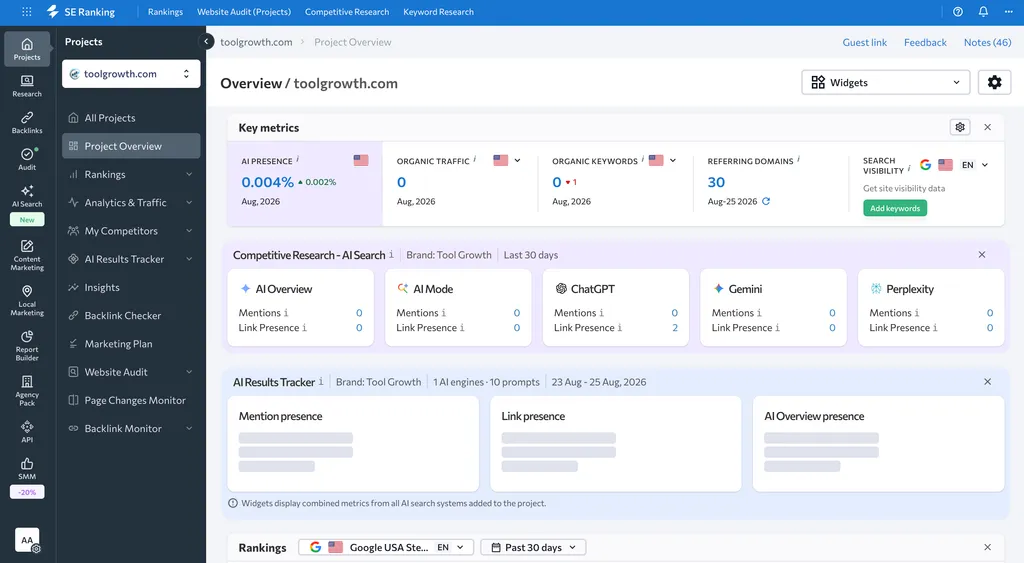
- GEO prompt tracking (100/day on Core, 250/day on Growth)
- Visibility across up to 5 LLMs
- GEO research on a limited number of domains (5 on Core, 15 on Growth)
- Unlimited AI sources tracking
Enough to start monitoring whether AI answers mention you.
- AI Results Tracker across AI Overviews, AI Mode, Perplexity, ChatGPT
- Unlimited AI competitor research
- Extra prompt capacity (200 / 450 / 1000 tiers)
- Access to SE Visible, the standalone AI-visibility dashboard
Needed for serious, ongoing AI-visibility work.
The practical difference: the included GEO tracking is a genuine, useful entry point — you can see whether your brand appears in AI answers without buying anything extra. But if AI visibility is a real priority (regular competitor benchmarking, deeper prompt sets, cross-platform tracking), you’ll want the add-on, which pushes a Core plan from $103.20 to roughly $174/month. That’s the number to compare against dedicated AI-visibility platforms, not the base price.
Honest limitation: SE Ranking’s AI tooling is maturing quickly and its big advantage is that it sits next to your existing SEO projects rather than in a separate silo. But standalone GEO specialists (Profound and similar) still go deeper on citation-level analytics and prompt research. Our take: for teams who want “good enough” AI visibility attached to the SEO work they already do, SE Ranking is a sensible, cost-effective choice. For teams whose primary job is AI-visibility strategy, a specialist will out-perform it. Don’t buy SE Ranking’s AI tools because they’re new — buy them because integrated, adequate tracking is worth more to you than deeper, separate tracking.
SE Ranking Pricing in 2026: What It Actually Costs
SE Ranking’s 2026 pricing is simple on the surface and more nuanced once you’re actually using it. Here are the verified numbers (checked against SE Ranking’s official pricing page, August 2026), followed by the cost factors that reviews often skip.
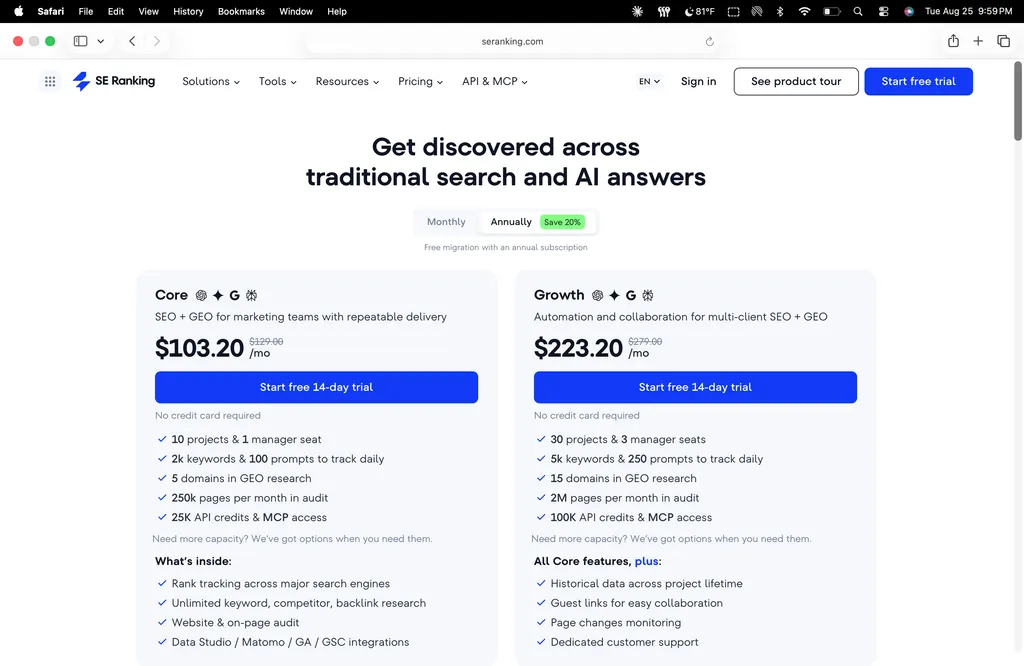
| Plan | Annual | Monthly | Key limits |
|---|---|---|---|
| Core | $103.20/mo | $129/mo | 10 projects · 1 seat · 2k keywords & 100 GEO prompts daily · 250k audit pages/mo · 25K API credits |
| Growth | $223.20/mo | $279/mo | 30 projects · 3 seats · 5k keywords & 250 GEO prompts daily · 2M audit pages/mo · 100K API credits · historical data |
| Enterprise | Custom | Flexible terms, custom limits, full API & advanced integrations | |
Annual billing saves 20% across the board, and a 14-day free trial (no credit card) lets you test the platform first. But the sticker price is a floor. Three things move your real cost:
- The keyword multiplier. Keyword limits are consumed per engine × location × device. Extra keywords run from $22.40/mo (Core) and $32/mo (Growth).
- Add-ons stack fast. AI Search (+$71.20/mo), Agency Pack (+$69/mo, annual only, for white-label + client tools), standalone API (+$45/mo), extra manager seats ($16/mo each), extra content articles ($39.20 each), extra local locations ($18.40/mo). Two or three of these can push you past Semrush’s or Ahrefs’ bundled pricing.
- Team size forces the tier. Core includes just one manager seat, so any team of two or more effectively needs Growth.
The bottom line on price: for basic rank tracking and auditing, SE Ranking is genuinely cheaper than Semrush or Ahrefs. That cost advantage narrows — and can disappear — once you add the AI Search toolkit, Agency Pack and extra keyword capacity. Model your actual required keywords, seats and add-ons before committing to an annual contract, because that’s what you’ll really pay.
Which SE Ranking Plan Is Right for You?
| If you’re a… | Start with | Why / what to watch |
|---|---|---|
| Freelancer / solo SEO | Core | One seat and 10 projects fit a solo workload. Skip add-ons until you actually need white-label or heavy AI tracking. |
| Small business (in-house) | Core | Plenty for one or a few sites. Add extra keywords only if you track many locations/devices. |
| Small-to-mid agency | Growth + Agency Pack | 3 seats, 30 projects and historical data suit client work; Agency Pack adds white-label reporting and client seats. |
| B2B / content-led team | Growth (+ AI Search) | Historical data and higher limits help; add AI Search if GEO visibility is a KPI. |
| Larger / enterprise team | Enterprise | Custom limits — but benchmark data depth against Ahrefs/Semrush first (see comparison below). |
When upgrading is justified: move from Core to Growth when you add team members (you need more than one seat), when you manage more than ~10 projects, or when you need historical data across a project’s lifetime. If you’re only hitting keyword limits, buying extra keywords is often cheaper than a full tier jump — do the math first.
What SE Ranking Can Replace — and What It Can’t
The real value question isn’t “is it good?” — it’s “how many other subscriptions can it retire?” Based on our own use plus verified capabilities, here’s the honest consolidation picture.
- A standalone rank tracker
- A separate site-audit / crawler tool
- An everyday keyword-research tool
- A client-reporting / dashboard tool
- Basic local-SEO rank tracking
- An entry-level AI-visibility monitor (with the add-on)
- Deep backlink research (Ahrefs)
- Active link-building outreach workflows
- The very deepest keyword/competitor gap analysis
- Best-in-class, citation-level AI-visibility (Profound & similar)
- Broad marketing suites (PPC, social, market data — Semrush)
For a freelancer or small agency, SE Ranking can realistically be the only SEO subscription you need. For a link-building specialist or an enterprise team, it works best as the affordable core of a stack that still includes one or two specialist tools — the consolidation saving is real, but it’s partial, not total.
SE Ranking vs Semrush vs Ahrefs: Task by Task
Generic “Ahrefs is better” claims don’t help you choose. This table compares the tools on the jobs you’ll actually do, and names the best choice for each. Data-depth rows draw on published documentation and third-party reporting rather than our own benchmarking.
| Job | SE Ranking | Semrush | Ahrefs | Best choice when… |
|---|---|---|---|---|
| Rank tracking | Excellent, granular, cheap | Good | Good | SE Ranking for value + local depth |
| Keyword research | Solid, smaller DB | Excellent | Excellent | Semrush/Ahrefs for depth; SE Ranking for value |
| Backlinks | Adequate | Strong | Best-in-class | Ahrefs for link data |
| Site audit | Strong, actionable | Strong | Strong | Tie — SE Ranking wins on price |
| AI visibility | Good (add-on for depth) | Strong (AI Toolkit) | Good (Brand Radar) | Semrush for depth; SE Ranking for integration + value |
| Reporting | Excellent, white-label | Good (paid add-on) | Limited | SE Ranking for agencies |
| Agency workflows | Strong (Agency Pack) | Strong | Limited | SE Ranking for affordable white-label |
| Ease of use | Approachable, modular | Feature-dense | Clean | SE Ranking/Ahrefs for newcomers |
| Overall value | Excellent (budget) | Premium | Premium | SE Ranking for cost-conscious teams |
Choose SE Ranking if value, rank tracking and client reporting matter most. Choose Ahrefs if backlinks and link-building are central. Choose Semrush if you need a broad marketing suite (PPC, social, market data) or the deepest AI-visibility toolkit. Choose a specialist AI platform if AI-visibility strategy is your primary job.
What We Liked
- Accurate, granular rank tracking — ZIP-level targeting makes local campaigns easy to monitor, which is the single feature that keeps us subscribed.
- Actionable site audits — issues come with fix instructions, so audits turn into to-do lists rather than just problem reports.
- Genuinely affordable for the breadth — no other tool packs this much into a plan around the $103/mo mark.
- Excellent white-label reporting — for agencies, scheduled branded reports and guest links save real time each month.
- MCP + API for 2026 workflows — pulling SE Ranking data into AI/automation workflows is a real, current advantage.
The Honest Cons
- The real price hides in add-ons and multipliers — the base plan is cheap, but AI Search, Agency Pack and keyword overages can quietly double it. This matters because the “budget option” framing only holds if you stay near the base plan.
- Data depth trails the leaders — smaller keyword database and backlink index than Ahrefs/Semrush (per documentation). This matters for deep enterprise research, less so for everyday SMB/agency work.
- The experience is modular, not unified — you switch between separate research tools rather than one explorer, which adds friction versus Ahrefs/Semrush.
- No link-building execution workflow — great at showing link data, but you’ll manage outreach elsewhere.
- Plan/trial limits are easy to confuse — a widely reported (and, in our experience, fair) complaint: it takes effort to work out what the advertised allowances mean once keywords, locations, engines and add-ons start multiplying.
Score Breakdown: How We Reached 4.2/5
Each category below was scored from evidence first — our hands-on experience where we have it, and verified documentation where we don’t — then averaged (with rank tracking and value weighted slightly higher, since they’re the core reasons the target audience buys SE Ranking). We’re showing the reasoning so the number is auditable, not arbitrary.
| Category | Score | Basis & one-line reason |
|---|---|---|
| Rank tracking & reporting | 4.6 | Hands-on. Accurate, granular, great white-label reporting; keyword multiplier is the only real drawback. |
| Keyword & competitor research | 4.0 | Hands-on + docs. Solid everyday workflow; smaller DB and modular UX hold it back from category-leading. |
| Website audit | 4.4 | Hands-on. Actionable fixes and strong crawl config; less transparent scoring than Ahrefs. |
| Backlink analysis | 3.5 | Documented evidence. Covers essentials; behind Ahrefs on index depth, no outreach workflow. |
| AI Search / GEO | 3.8 | Hands-on + docs. Useful included tracking; full depth needs the add-on; specialists go deeper. |
| Reporting & agency features | 4.4 | Hands-on. Excellent white-label and guest links; best-in-class value for agencies. |
| Value for money | 4.2 | Verified pricing. Cheaper than rivals at base; add-ons/multipliers narrow the gap. |
| Ease of use | 4.2 | Hands-on. Approachable interface; modular structure adds some friction. |
| Overall (weighted) | 4.2 | A strong, defensible score for a high-value all-in-one with honest, specific limitations. |
Who Should Use SE Ranking? (And Who Shouldn’t)
This is the decision section. Find yourself below, and note the honest “don’t buy this if” that follows — that’s the part most affiliate-driven reviews skip.
- Freelance / solo SEOs — strong fit. You get rank tracking, audits, research and reporting in one affordable subscription. Start on Core. Consider alternatives if your entire business is link building.
- Small businesses — strong fit. Reliable tracking and actionable audits without agency-level cost or complexity. Consider alternatives if you only need occasional keyword research — a cheaper tool like Mangools may be enough.
- Small-to-mid agencies — the sweet spot. White-label reporting, guest links and multi-project management make client work efficient. Growth + Agency Pack. Consider alternatives if deep backlink intelligence is your core service.
- B2B / content-led teams — good fit, especially with historical data and (optionally) AI Search for GEO KPIs. Consider alternatives if you need broad marketing intelligence beyond SEO — that’s Semrush territory.
- Larger / enterprise teams — conditional. It can work as an affordable core, but benchmark data depth first; you may still need Ahrefs/Semrush alongside it.
- You need the deepest possible backlink index — go with Ahrefs.
- Your work depends on link-building outreach workflows — SE Ranking has none built in.
- You want a best-in-class, standalone AI-visibility platform — a specialist (e.g. Profound) will go deeper.
- You only need occasional keyword lookups — the full subscription is hard to justify; use a lighter tool.
- You’re unwilling to model add-ons and limits before committing — the real cost will surprise you.
How We’d Actually Use It: A First-Project Workflow
Feature lists don’t show how a tool fits real work. Here’s the sequence we’d follow setting up a new project — and, more importantly, the decision you make at each step, what SE Ranking helps with, and where it stops short.
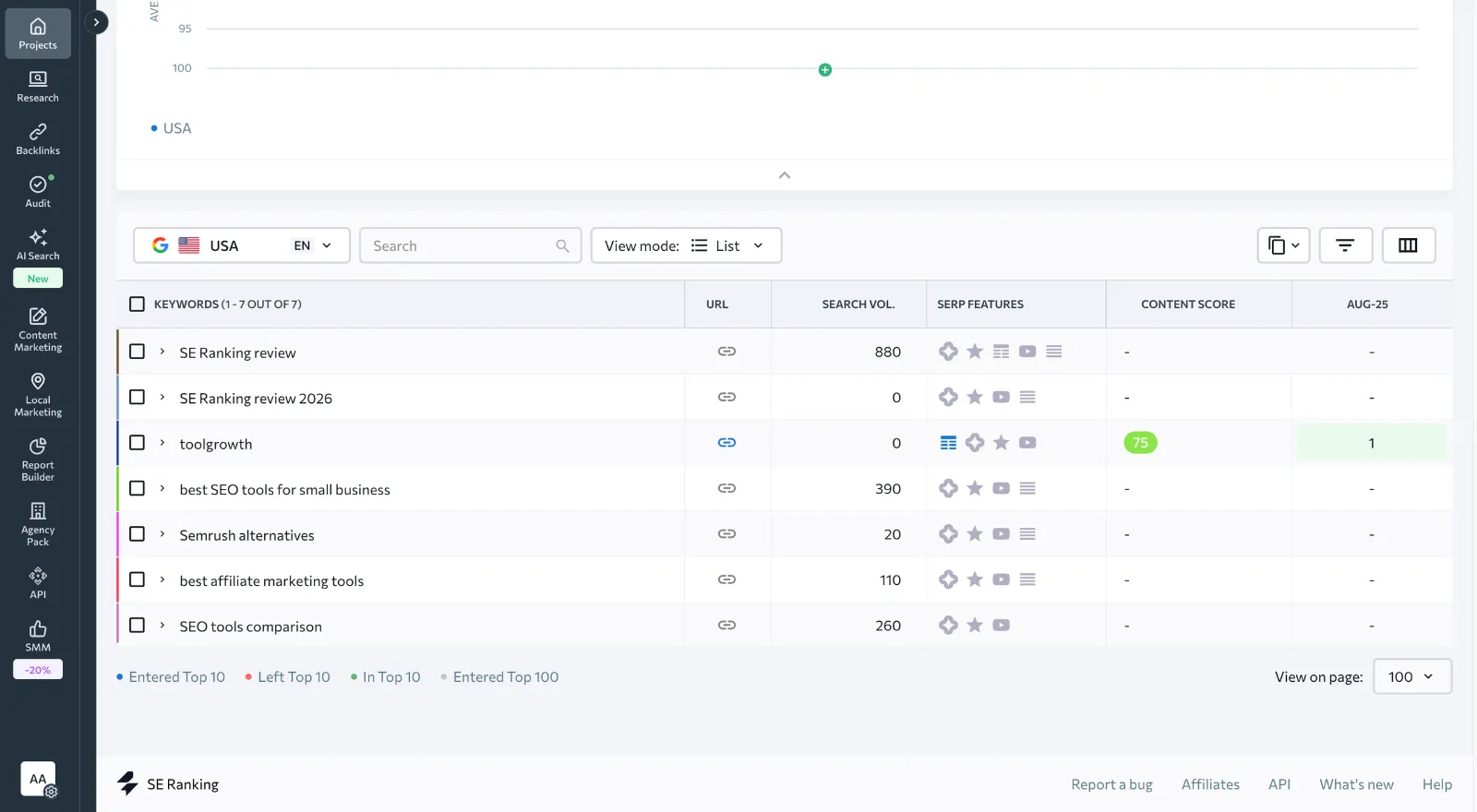
Decision: which engines, locations and devices to track. SE Ranking helps: fast setup, ZIP-level targeting, optional auto-audit. Watch: every engine × location × device eats keyword quota — start lean.
Decision: which terms are worth targeting. SE Ranking helps: volume, difficulty, intent, bulk analysis, clustering. Watch: for deep or unusual long-tail research, a larger-database tool may surface more.
Decision: where the gaps and opportunities are. SE Ranking helps: competitor keywords, traffic estimates, gap views. Watch: discovery is spread across separate tools, so expect some context-switching.
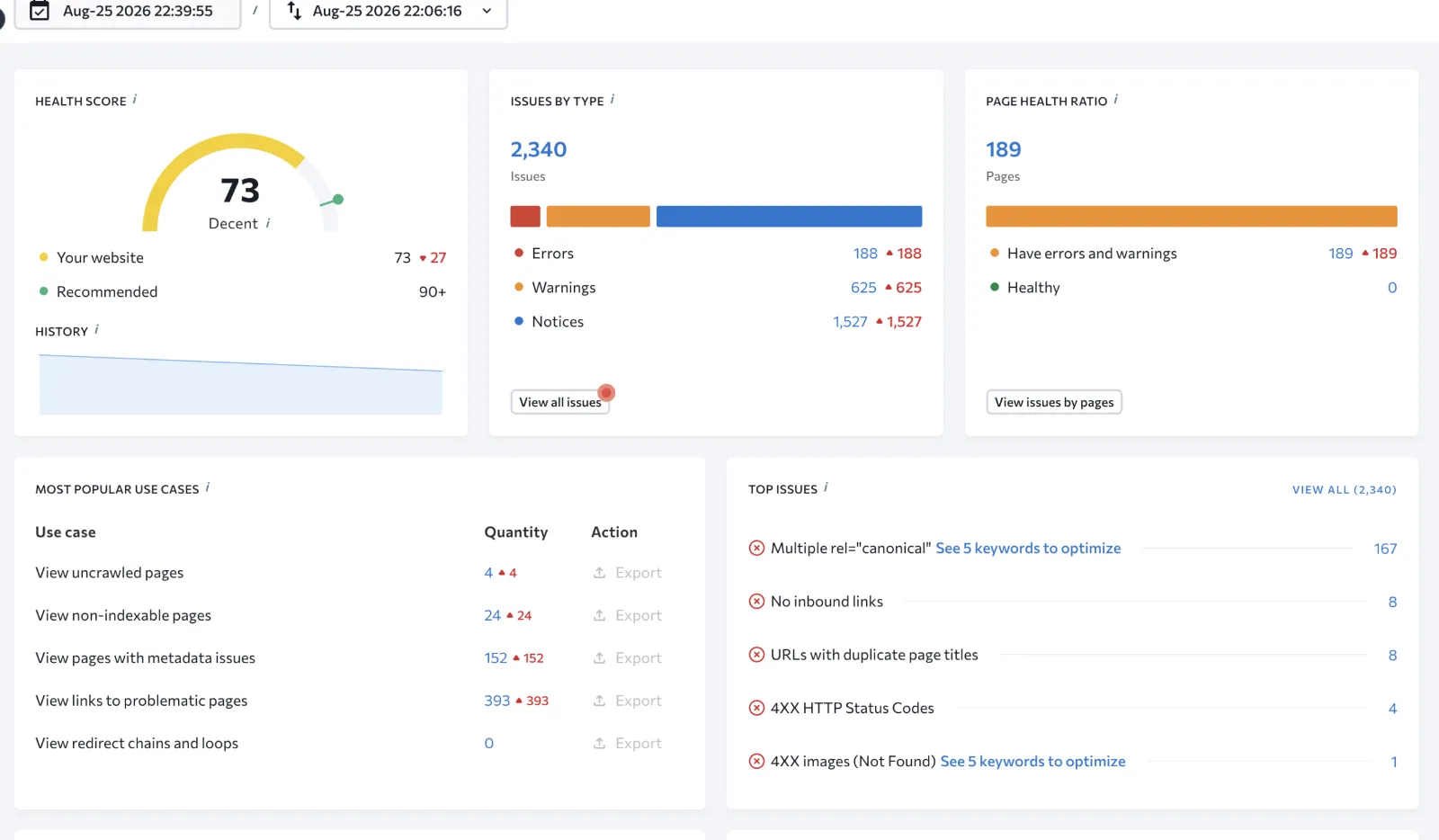
Decision: what to fix first. SE Ranking helps: Health Score, prioritised issues with fix instructions. Watch: you can’t tune how the score is weighted.
Decision: how to improve target pages. SE Ranking helps: On-Page Checker, competitor-driven content briefs, MCP for AI workflows. Watch: don’t chase every suggested term; article allowances are limited.
Decision: is it working? SE Ranking helps: daily rankings, Insights, Page Changes Monitor, optional AI-visibility tracking. Watch: deeper AI tracking needs the add-on.
Decision: how to show progress. SE Ranking helps: white-label Report Builder, scheduled delivery, guest links, Looker Studio. Watch: white-label reporting at scale is an Agency Pack feature.
What Users Consistently Say
Looking across public review platforms (G2, Gartner Peer Insights, Trustpilot), a few themes come up repeatedly — we’re reporting the recurring patterns, not cherry-picked quotes. The consistent praise: it’s easy to use and approachable for newcomers, strong value versus Semrush/Ahrefs, and reliable, helpful reporting for client work. The recurring criticism: data depth (keywords and backlinks) trails the market leaders, plan/allowance limits can be confusing, and the real cost climbs once add-ons are involved. Notably, these recurring complaints line up almost exactly with the limitations we’ve flagged from our own use — which is part of why we’re comfortable standing behind them.
Does SE Ranking Have an Affiliate Program?
Yes. SE Ranking runs an affiliate program that pays a 30% commission on subscription sales you refer, with no earnings cap. According to SE Ranking’s official affiliate page, referred users are tracked with a 120-day cookie, and once a referral signs up you remain credited as the referring affiliate for that user. Payouts are made twice a month via PayPal once your balance reaches the $50 minimum, and you can join even with a free account. (SE Ranking’s page states 30% on each subscription sale; we’re not claiming a lifetime “recurring” rate beyond what’s officially published.)
Alternatives to SE Ranking
No tool is right for everyone. Here’s where each main alternative makes more sense:
- Semrush — choose it when you need a broad marketing suite (PPC, social, market intelligence) or the deepest AI-visibility toolkit, and budget is secondary. See our Semrush review for the full breakdown.
- Ahrefs — choose it when backlink analysis and link building are central to your work. It’s the reference standard for link data.
- Mangools — choose it if you’re a solo user or small site that only needs the essentials at a lower price. Our Mangools review covers whether it’s enough.
- Moz Pro — choose it for an established, approachable all-round SEO suite with a strong learning ecosystem.
- A specialist AI-visibility tool (e.g. Profound) — choose it when GEO/AI-visibility strategy is your primary job and you need citation-level depth.
Still weighing your options? Our roundup of the best Semrush alternatives in 2026 puts these tools side by side, and the best SEO tools for small business guide is a good starting point if you’re early in your search.
Frequently Asked Questions
Is SE Ranking good for beginners?
Yes. In our experience it’s one of the more approachable all-in-one platforms — the interface is clean and audits come with plain-language fix guidance, which helps if you’re newer to SEO. The main learning curve is understanding how plan limits (keywords × locations × devices) and add-ons work.
How much does SE Ranking cost in 2026?
The Core plan is $103.20/month billed annually ($129 monthly) and Growth is $223.20/month annually ($279 monthly); Enterprise is custom-priced. Annual billing saves 20%, and there’s a 14-day free trial with no credit card. Add-ons like AI Search (+$71.20/mo) and Agency Pack (+$69/mo) increase the total. Verified against SE Ranking’s official pricing page, August 2026.
Is SE Ranking’s ranking data accurate?
In our experience, yes — rank tracking is the platform’s strongest area, with accurate daily updates and reliable location targeting down to ZIP-code level. It’s the main reason we’ve kept using it.
Does SE Ranking track AI Search and GEO?
Yes. Basic GEO/AI-visibility tracking (across Google AI Overviews, AI Mode, ChatGPT, Gemini and Perplexity) is included in the Core and Growth plans, with daily prompt limits. Fuller capability — the AI Results Tracker, unlimited AI competitor research and access to the SE Visible dashboard — sits behind a separate AI Search add-on (around $71.20/month annual). For serious AI-visibility work, budget for the add-on.
SE Ranking vs Ahrefs: which should you choose?
Choose SE Ranking for value, rank tracking, audits and affordable white-label client reporting. Choose Ahrefs if backlink research and link building are central to your work — its link index and analytical depth remain the market benchmark. Many teams on a budget use SE Ranking as their core and keep Ahrefs only if links are a core service.
Final Verdict: Is SE Ranking Worth It in 2026?
Yes — for the right team. After long-term hands-on use and current 2026 verification, our view is that SE Ranking is one of the best-value all-in-one SEO platforms available, and the 2026 additions (AI Search Toolkit, MCP, API) make it more capable than the tool we started with. Its strength isn’t any single best-in-class database; it’s how rank tracking, audits, research, reporting and AI visibility fit together at a price well below the enterprise suites. The honest caveat: the clean base price hides real cost once add-ons and keyword multipliers enter the picture, so consolidation is the reason to buy it — not a spectacular data advantage.
- Choose SE Ranking if you want rank tracking, audits, research and client reporting in one affordable place.
- Consider Ahrefs if backlinks and link building are central.
- Consider Semrush if you need a broad marketing suite or the deepest AI-visibility toolkit.
- Consider a specialist AI platform if AI-visibility strategy is your primary job.
If you’re weighing it up, the 14-day free trial (no credit card) is the sensible next step — set up one real project, model the keyword and add-on limits your workflow actually needs, and you’ll know within a week whether the consolidation value is there for you. You can compare current plans and limits on the official SE Ranking website.