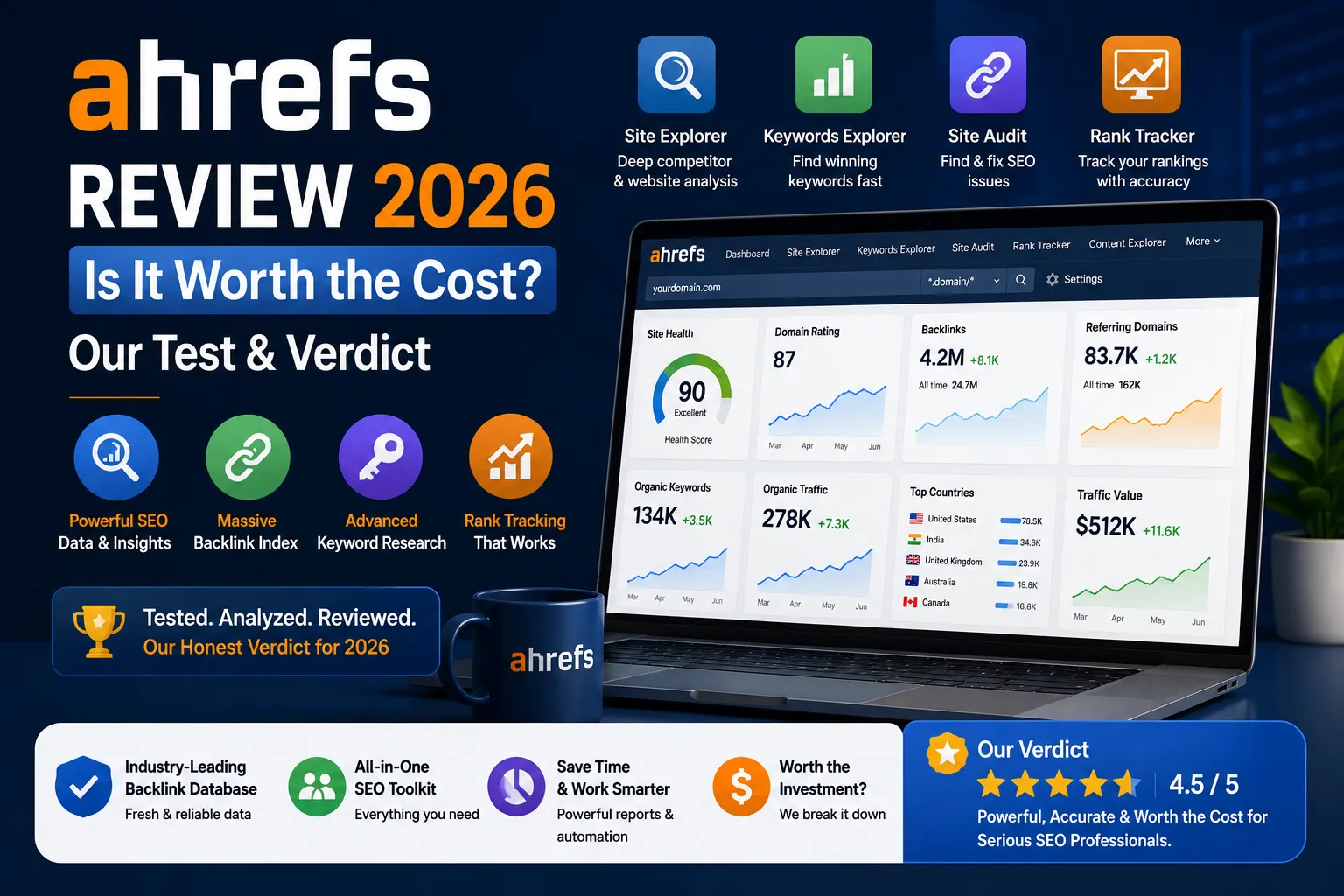
Ahrefs doesn’t need an introduction — it needs a straight answer. It’s one of the most recognisable names in SEO, and also one of the most expensive. The question that actually matters isn’t “is Ahrefs good?” It’s whether that quality justifies its price for your specific work, or whether a cheaper tool would get you 80% of the value for a fraction of the cost.
This review is based on structured, hands-on testing across Site Explorer, backlink analysis, Link Intersect, Content Gap, Keywords Explorer, Site Audit and Brand Radar — using a real client project (with permission) rather than generic examples. We didn’t complete hands-on testing of Rank Tracker due to a connectivity issue during testing, and we say so plainly rather than guessing. Every price in this article was checked directly against Ahrefs’ official pricing page and Help Center on 27 August 2026.
What Is Ahrefs?
Ahrefs is a web-based SEO platform built around one of the largest independent web crawlers in the industry — historically its biggest strength has been backlink data. Over time it has expanded well beyond that: keyword research, technical site audits, content discovery, and, most recently, AI-visibility tracking through Brand Radar.
At its core, Ahrefs answers three questions for SEO professionals: who is linking to a site (and why), what people are actually searching for, and how a site is performing technically. Everything else — Content Gap, Link Intersect, Brand Radar — is built on top of that same underlying data.
What Changed in Ahrefs for 2026?
A few verified, current changes matter if you last looked at Ahrefs a year or two ago:
- Ahrefs now offers a $29/month Starter plan. It sits below Lite and gives credit-based access to Site Explorer and Keywords Explorer, plus a small Rank Tracker allowance (50 keywords) — a genuinely lower-cost way in than before.
- Brand Radar’s availability and capabilities vary by plan. Custom tracked AI prompts are included from Lite upward (5 prompts/150 checks monthly on Lite, scaling up on higher tiers). A separate Brand Radar AI add-on, starting from $199/month for a single-platform AI index, unlocks broader brand and competitor research across Ahrefs’ full prompt database — more on this distinction below.
- AI Content Helper and an MCP Server are now part of the product line, reflecting Ahrefs’ push into AI-assisted workflows alongside traditional SEO.
- Still no free trial. Ahrefs’ own pricing FAQ states plainly that it doesn’t run discounts or trials — this hasn’t changed.
How We Tested Ahrefs
This review is based on fresh, structured testing rather than long-term daily use. Here’s exactly what that involved:
- Tested: Site Explorer and backlink analysis, Referring Domains, Anchors, Link Intersect, Content Gap, Keywords Explorer, Site Audit, and Brand Radar/AI visibility.
- Test subject: A real client website (experte.com, a VPN/tech comparison site — used with the client’s permission) for backlink and competitor-research testing, plus a second client project (“Ennovanest”) for Site Audit.
- Not tested: Rank Tracker. We ran into a network issue during testing and didn’t complete this section. Rather than delay the whole review or fake a result, we’re covering Rank Tracker using Ahrefs’ own current documentation only, clearly labelled as such.
- Pricing: Verified separately, directly from Ahrefs’ official pricing page and Help Center, on 27 August 2026 — not taken from any competitor article or older source.
Ahrefs Pricing: Advertised Price vs Real Cost
Pricing checked on ahrefs.com/pricing and help.ahrefs.com, 27 August 2026.
| Plan | Price | Projects | Tracked keywords | Historical data | Users included |
|---|---|---|---|---|---|
| Ahrefs Free | $0 | Limited Site Explorer + full Site Audit, for your own verified sites only | |||
| Starter | $29/mo | 1 unverified + unlimited verified | 50 | 1 month | 1 user; additional users cannot be added |
| Lite | $129/mo | 5 | 750 | 6 months | 1 (+2 at $40/mo each) |
| Standard | $249/mo | 20 | 2,000 | 2 years | 1 (+5 at $60/mo each) |
| Advanced | $449/mo | 50 | 5,000 | 5 years | 1 (+10 at $80/mo each) |
| Enterprise | $1,499/mo | Unlimited | 10,000+ | Unlimited | From 3 (+$100/mo each) |
Annual billing saves up to 17%, per Ahrefs’ own pricing page. There is genuinely no free trial — Ahrefs’ pricing FAQ states it directly: “We never run discounts. But if you’re a website owner, you can sign up for Ahrefs Free to get free limited access to Site Explorer & Site Audit.” The $29 Starter plan is the realistic way to test the platform properly before committing to Lite or above.
- Extra seats aren’t cheap. $40/mo (Lite), $60/mo (Standard) or $80/mo (Advanced) per additional user. A 3-person team on Standard costs $249 + $120 = $369/month before add-ons.
- Brand Radar’s deeper tier is separate. The AI-prompt tracking included from Lite upward is modest (5–20 prompts). The standalone Brand Radar AI add-on — which unlocks research across Ahrefs’ full 475M+ prompt database, including competitors — starts from $199/month for a single-platform AI index.
- Content Kit and Report Builder are separate line items too — Content Kit (AI Content Helper/Grader) from $99/month, and a higher-capacity Report Builder also at $99/month.
- Project Boost add-ons for faster, always-on Site Audit crawling run $20/month (Pro) or $200/month (Max) per project — this can add up fast across an agency’s client list.
None of this makes Ahrefs a bad deal — but it does mean the $129 or $249 headline number is a floor, not the full picture, especially for teams and anyone wanting deeper AI-visibility data.
Which Type of User Gets Enough Value?
| User type | Likely fit | Main value | Main concern | Verdict |
|---|---|---|---|---|
| Professional SEO | Strong | Backlink + competitor depth | Price at scale | Buy |
| Serious freelancer | Strong | Consolidated research | Lite plan feels tight | Buy (Lite/Standard) |
| In-house SEO team | Strong | One platform, less tool-switching | Seat costs for a team | Buy |
| SEO agency | Strong | Multi-project + competitor research | Per-seat and per-project add-on costs | Buy (Standard/Advanced) |
| Beginner blogger | Weak | More than needed | Cost vs. actual usage | Probably skip |
| Very small business | Weak | Site Audit + basic keywords | Hard to justify monthly cost | Consider Starter or a cheaper tool |
| Occasional keyword researcher | Weak | Overkill for the use case | Paying for depth you won’t use | Skip |
Hands-On Test — Site Explorer and Backlink Research
Before going link-by-link, the Site Explorer overview gives the same starting snapshot we’d check for any domain: experte.com currently shows a Domain Rating of 72, a URL Rating of 20, 24.5K backlinks, 4.4K referring domains, 14.1K organic keywords, and an estimated 217K in organic traffic. That last figure is Ahrefs’ own traffic estimate, not a substitute for the site’s actual analytics.
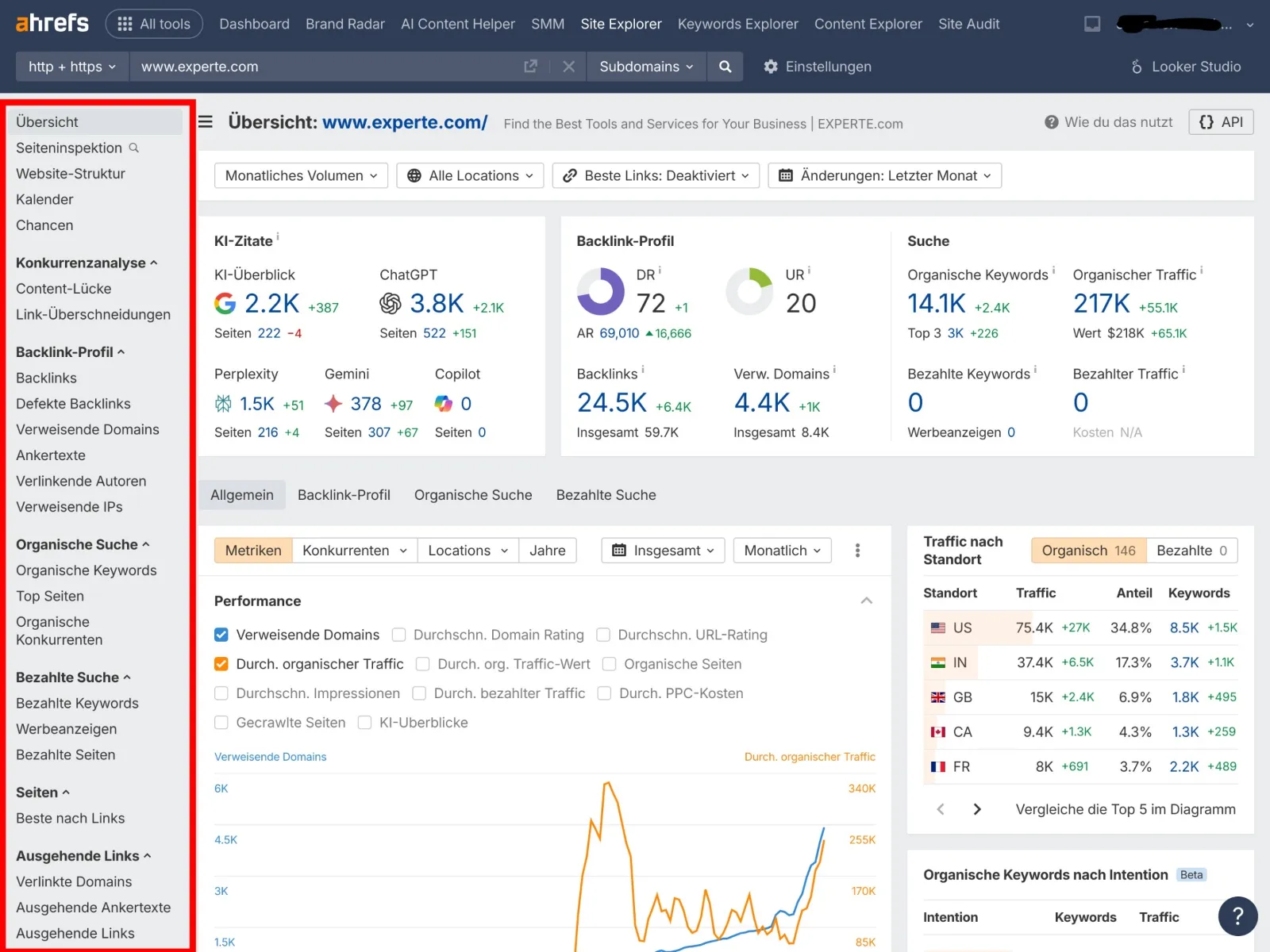
Site Explorer overview for experte.com: Domain Rating 72, URL Rating 20, 24.5K backlinks, 4.4K referring domains, 14.1K organic keywords, ~217K estimated organic traffic.
Starting with the overall backlink profile
During this testing, the normal workflow started the same way it always does: reviewing the overall backlink picture — referring domains, new and lost links, and general link quality — before ever looking at individual backlinks. Only after that does it make sense to inspect specific links and decide whether they come from genuinely relevant sites or whether the profile is mostly padded with low-value quantity.
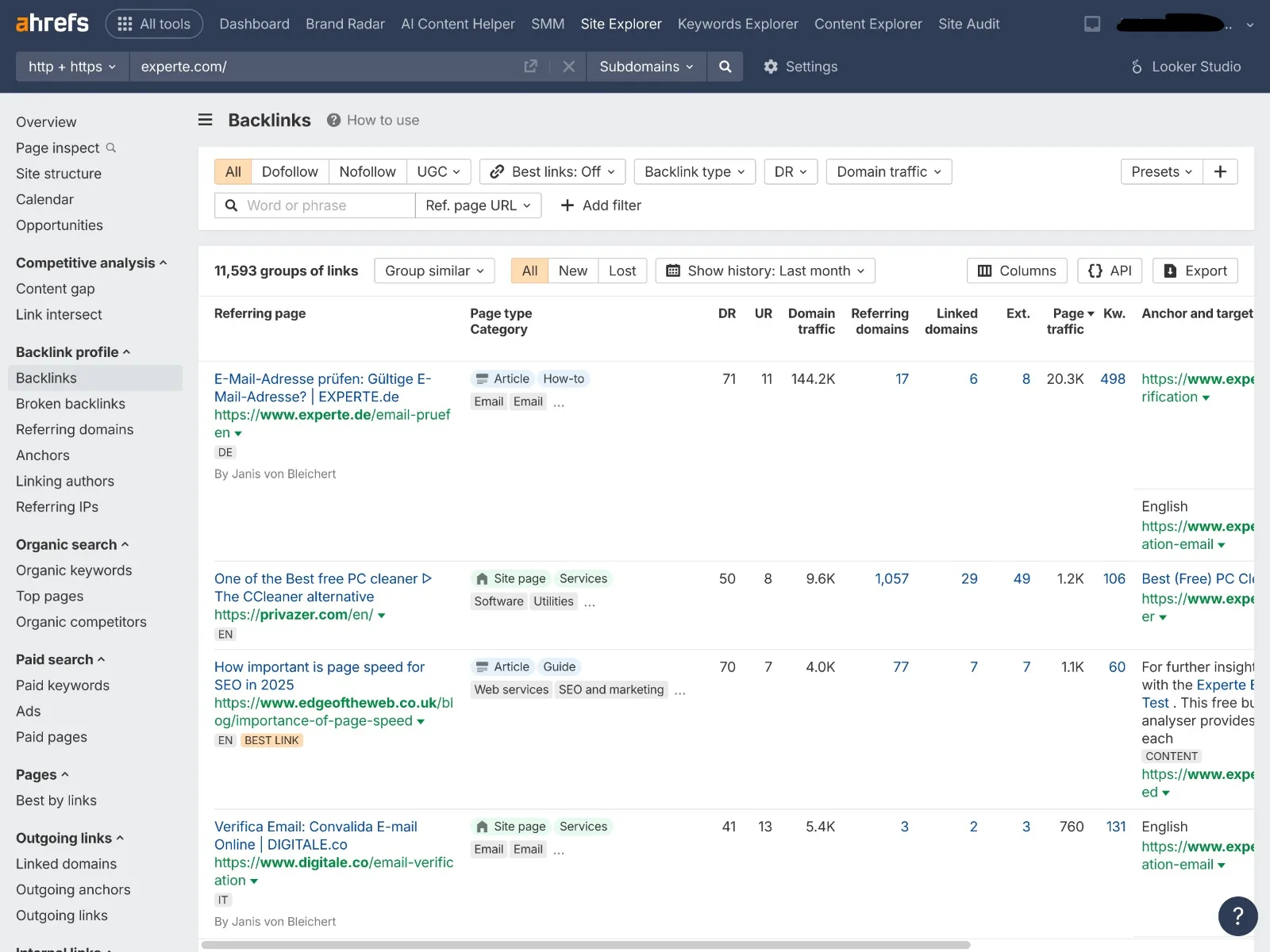
Ahrefs’ Backlinks report for experte.com, grouped into 11,593 link groups with DR, UR, domain traffic and anchor data visible per link.
With 11,593 groups of links surfacing for this one site, filtering and grouping stopped being optional and became essential. Browsing the raw list without applying DR, traffic, link-type or new/lost filters would make it almost impossible to separate genuinely useful links from noise.
Referring domains and anchor analysis
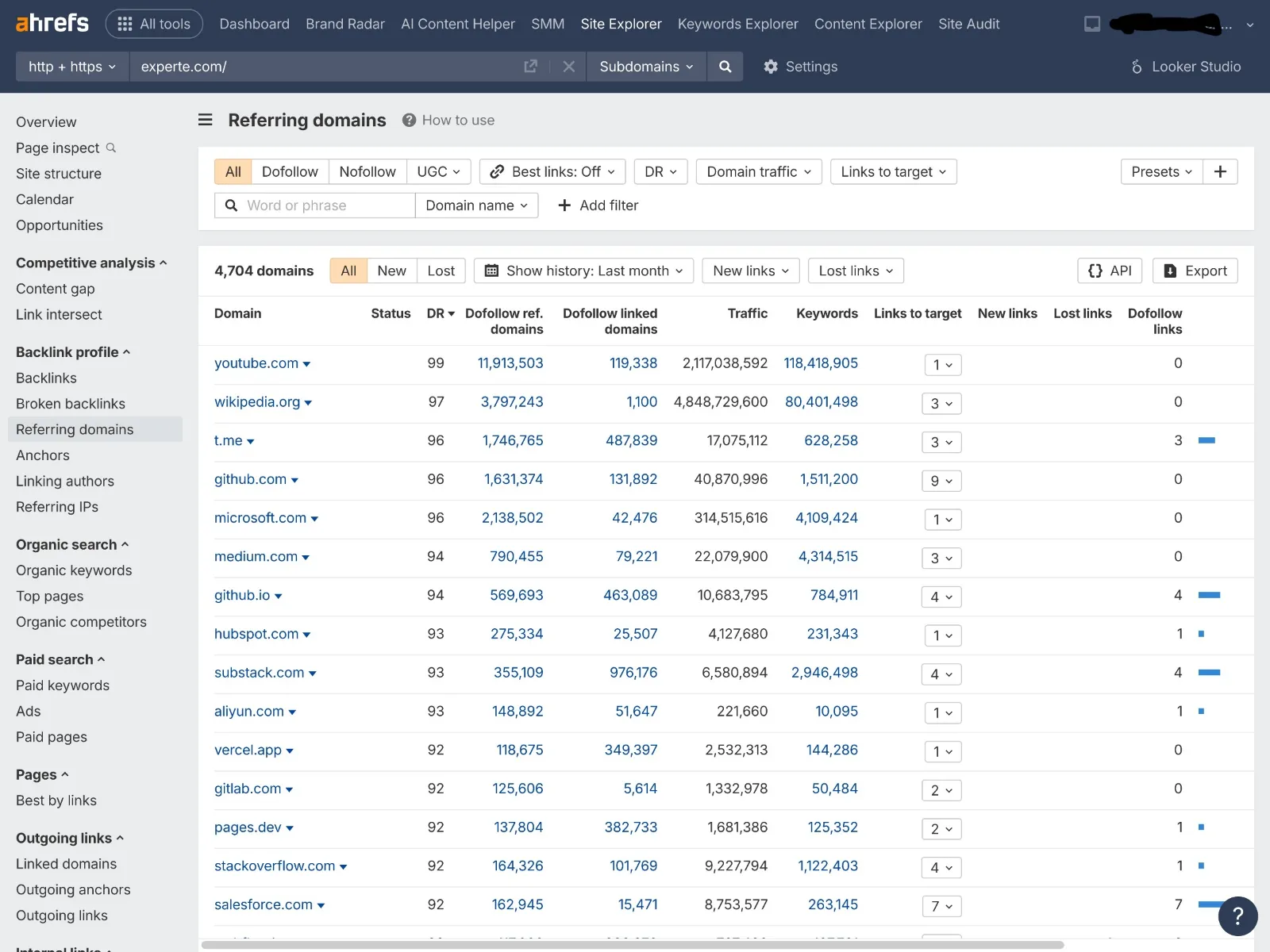
4,704 referring domains for experte.com, shown with DR, traffic, linking keywords and dofollow status.
What stood out most here was being able to inspect referring domains and pages alongside DR, traffic and link information in the same view. That combination gives more context about where a link actually came from and what it might realistically be worth — rather than just a raw backlink count that tells you almost nothing on its own. Domain Rating is a useful signal, but it isn’t a guarantee of link quality by itself; it still needs to be read alongside relevance and traffic.
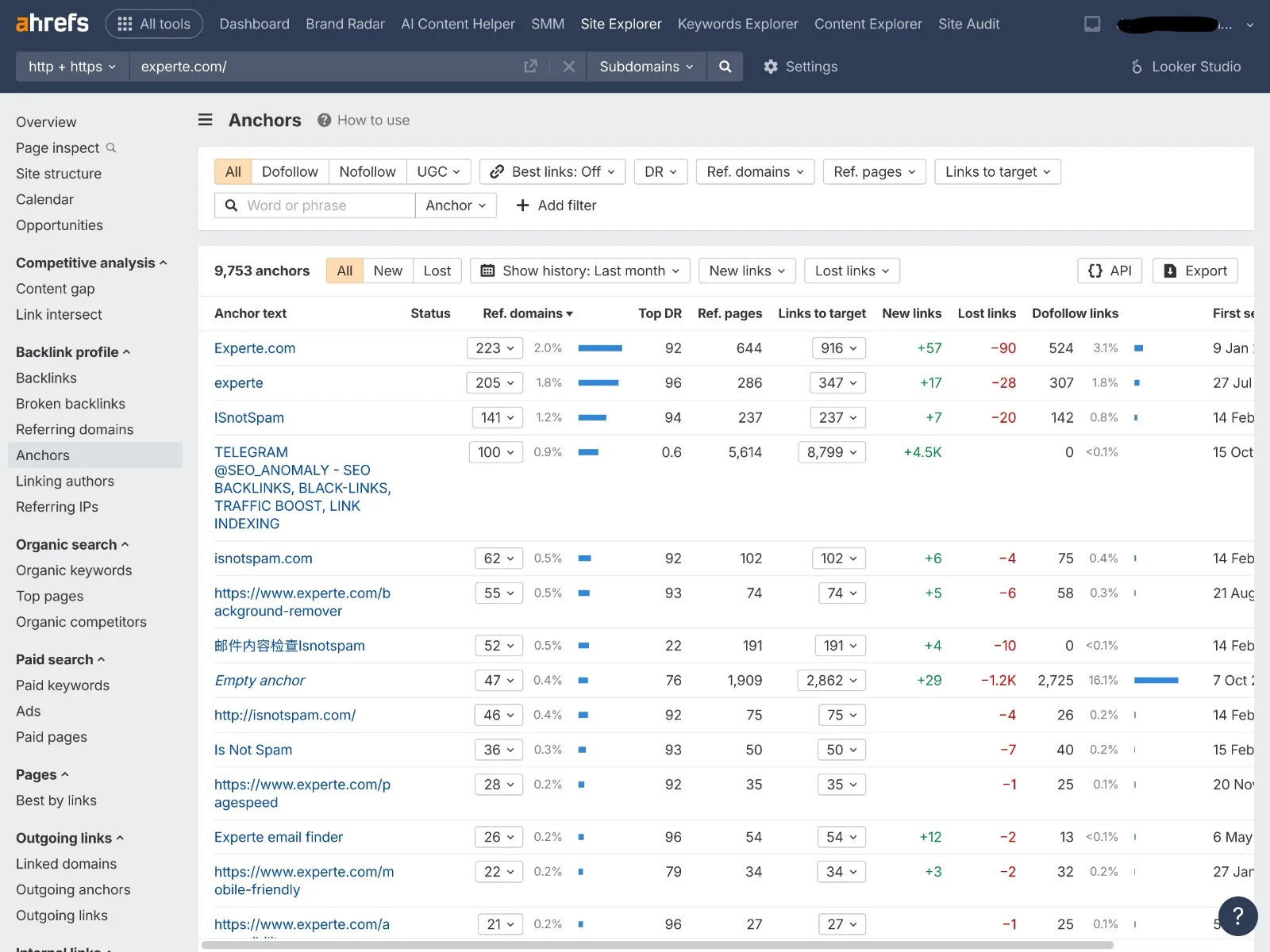
9,753 anchors identified for experte.com, with referring-domain counts and top DR shown per anchor.
The Anchors report (9,753 anchors for this site) demonstrates the same pattern: genuine depth, but depth that can feel overwhelming without deliberately narrowing the view first. This is a recurring theme across Ahrefs’ backlink tools — the data is there, but getting to a useful answer takes active filtering rather than passive scrolling.
Finding real opportunities with Link Intersect
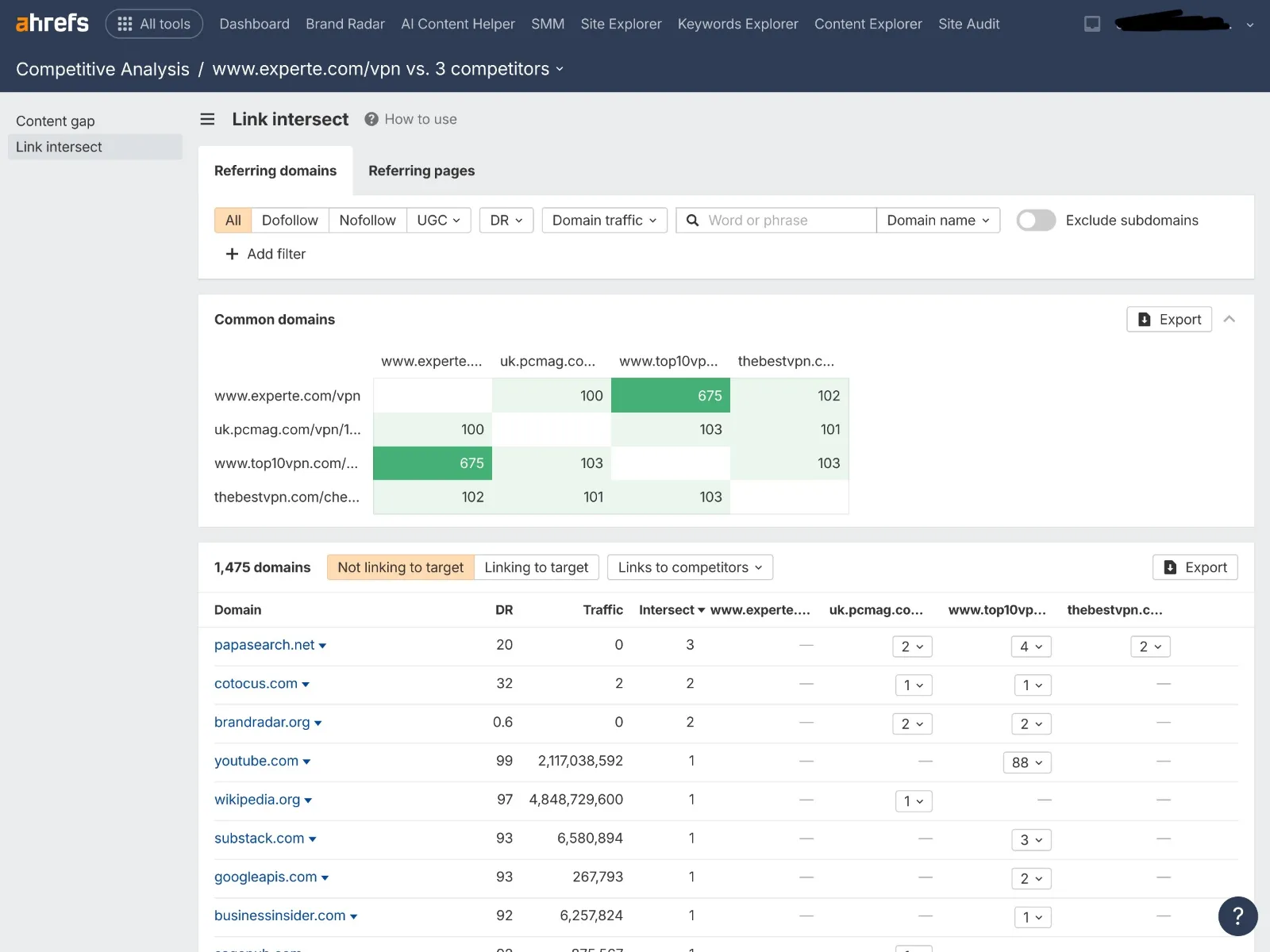
Link Intersect comparing experte.com/vpn against PCMag, Top10VPN and TheBestVPN — 1,475 domains link to at least one competitor but not to the target page.
Link Intersect turned competitor backlinks into a genuinely practical prospecting workflow rather than just another report to read. If a relevant domain linked to competing VPN pages but not to the target page, that became a natural, specific outreach candidate — not a guess. That said, not every domain the tool surfaces is automatically a good opportunity; relevance and quality still require a manual pass before any outreach.
What worked well, and what felt overwhelming
The clear positive is the depth of referring-domain and page-level data — it’s useful and dependable for competitor and link-profile analysis. The clear limitation is volume: on a site with thousands of link groups, the data can feel overwhelming fast unless you commit to filtering by DR, traffic and link type rather than browsing everything. Ahrefs’ backlink tools are strong, but they’re not a substitute for manual relevance and quality judgment.
Hands-On Test — Content Gap
Content Gap compares a target page against a set of competitors and surfaces keywords they rank for that the target doesn’t. On a larger scale, testing this against experte.com/vpn and three competitors surfaced 3,152 keywords where at least one competitor held a top-10 ranking and the target page had none at all.
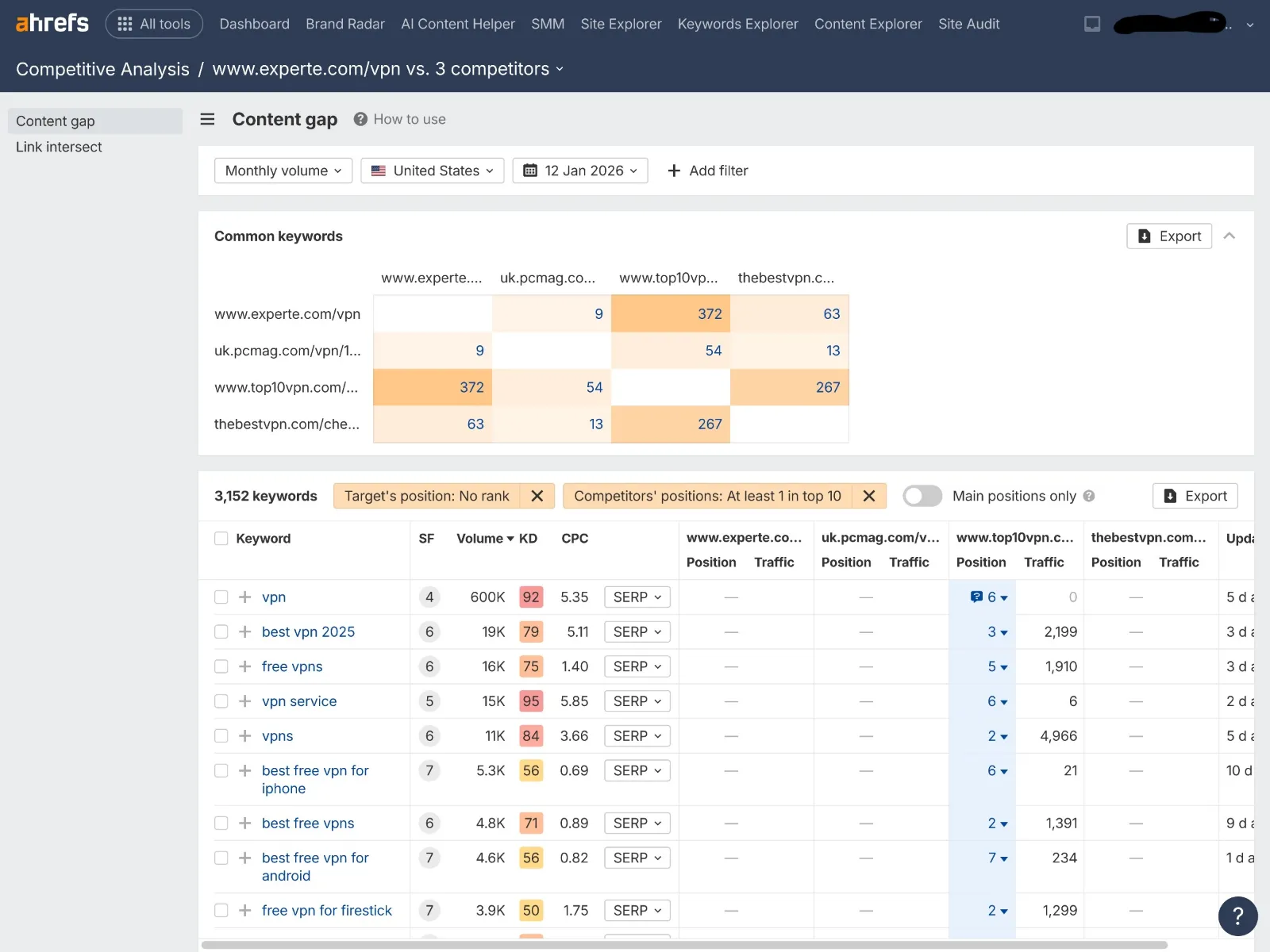
Content Gap for experte.com/vpn vs. three competitors, surfacing 3,152 potential keyword gaps.
A smaller, more granular run on the same target — this time comparing German-language VPN terms against the same competitor set — is a clearer illustration of what the report is actually useful for:
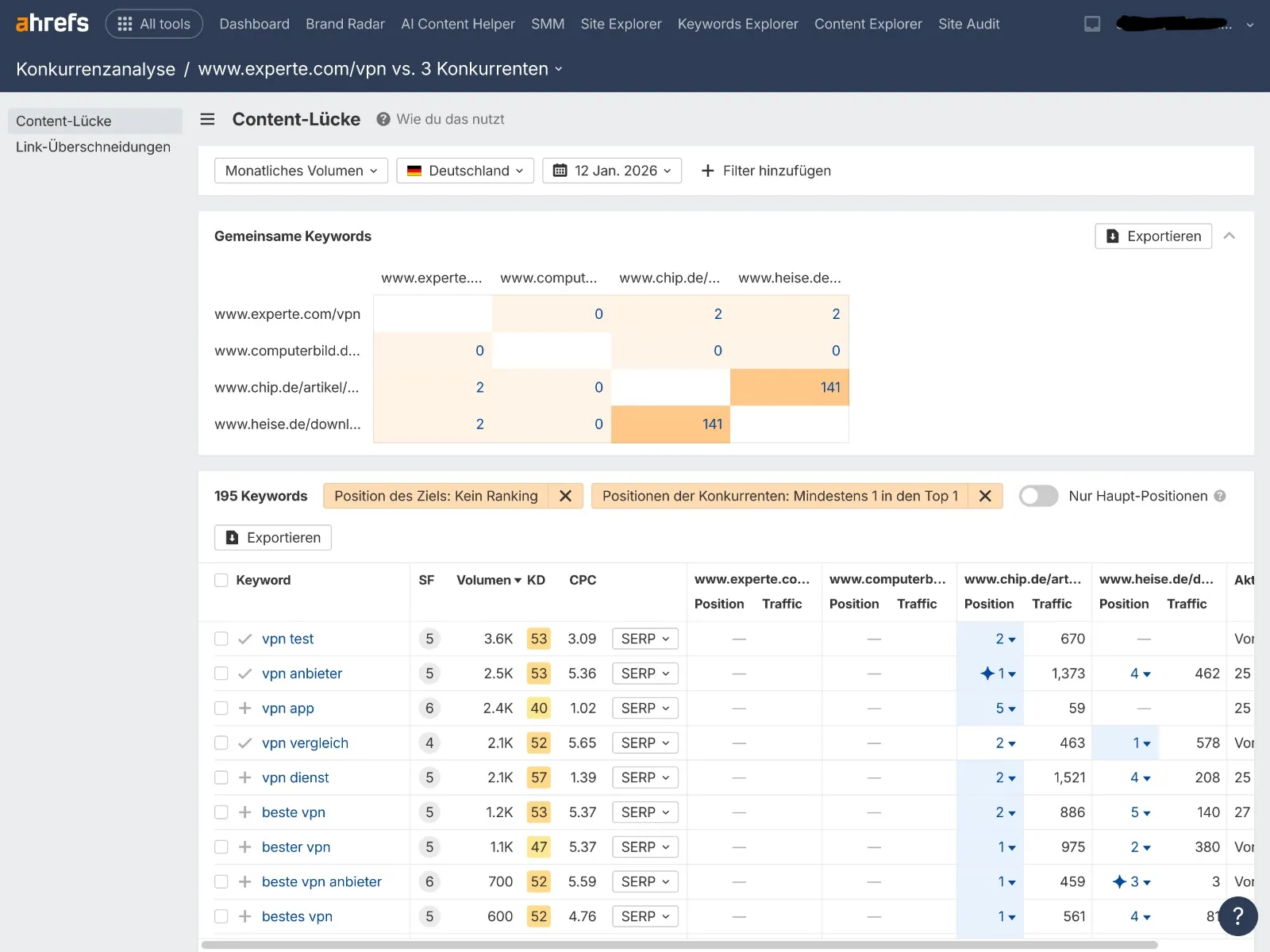
195 keywords in this narrower Content Gap run, including “vpn test” (3.6K volume), “vpn anbieter” (2.5K) and “vpn app” (2.4K).
There’s some noise, but the overall results were genuinely useful. This run surfaced a gap of 195 keywords, including “vpn test” at 3.6K volume, “vpn anbieter” at 2.5K, “vpn app” at 2.4K and “vpn vergleich” at 2.1K. That made it straightforward to identify terms competitors ranked for while the target page didn’t — directly, without guesswork. Even so, not every keyword the report surfaces has the right intent or business relevance, so search intent and relevance still need a manual review rather than treating every result as an automatic content recommendation.
From reports to a to-do list: the Opportunities dashboard
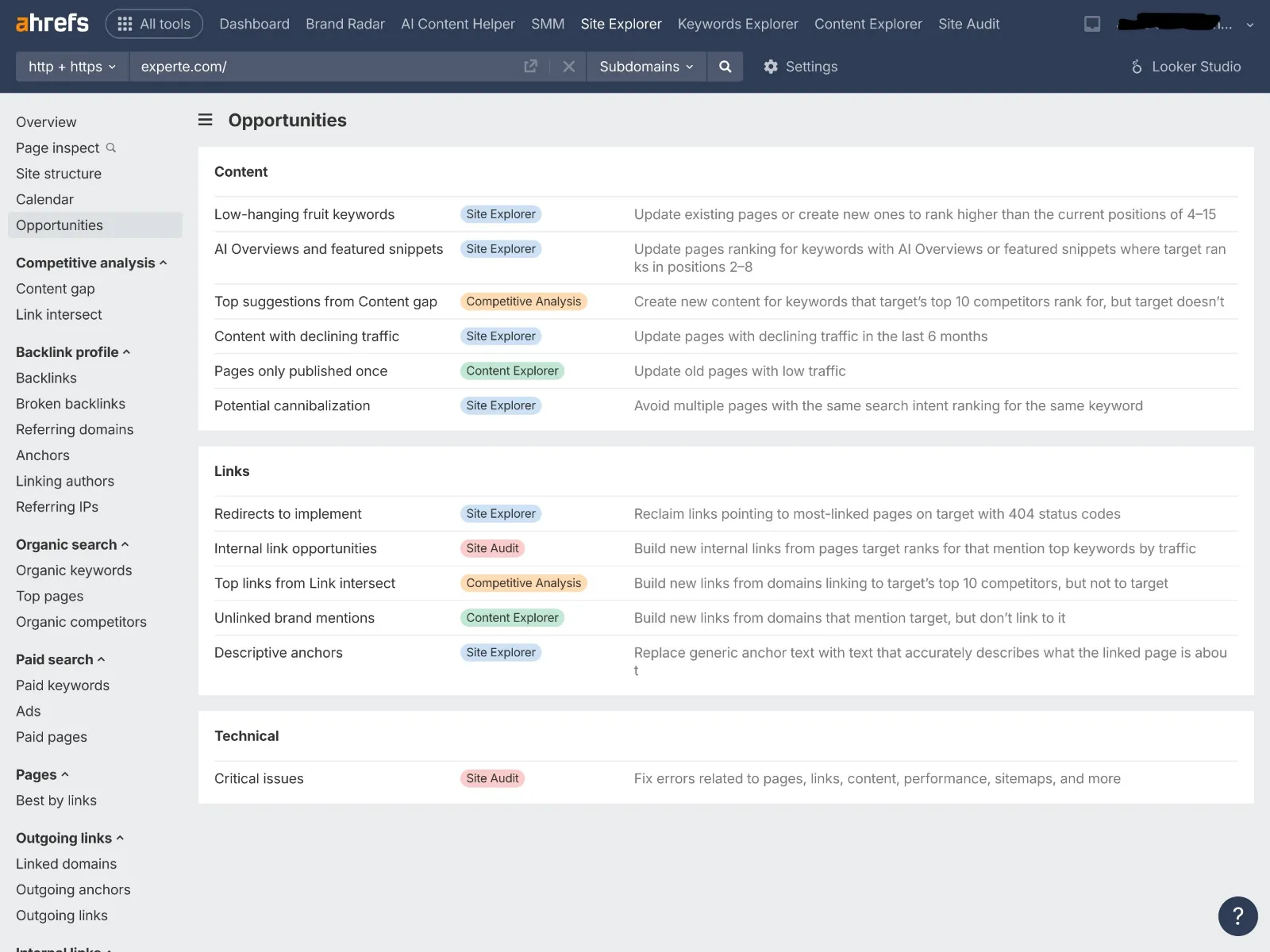
The Opportunities dashboard pulls Content Gap results, Link Intersect prospects, cannibalization and technical issues into one categorized list.
This dashboard is Ahrefs’ attempt to turn several separate reports — Content Gap, Link Intersect, declining content, cannibalization, technical issues — into action categories instead of raw data. It’s a genuinely useful organizing layer, but the suggestions inside it aren’t automatically correct just because they’re listed; they’re a starting point for prioritization, not a finished plan.
Hands-On Test — Keywords Explorer
To keep this section usable for readers outside any one niche, this test used a broadly recognizable topic — “low carb diet” — rather than a narrow example only relevant to one industry.
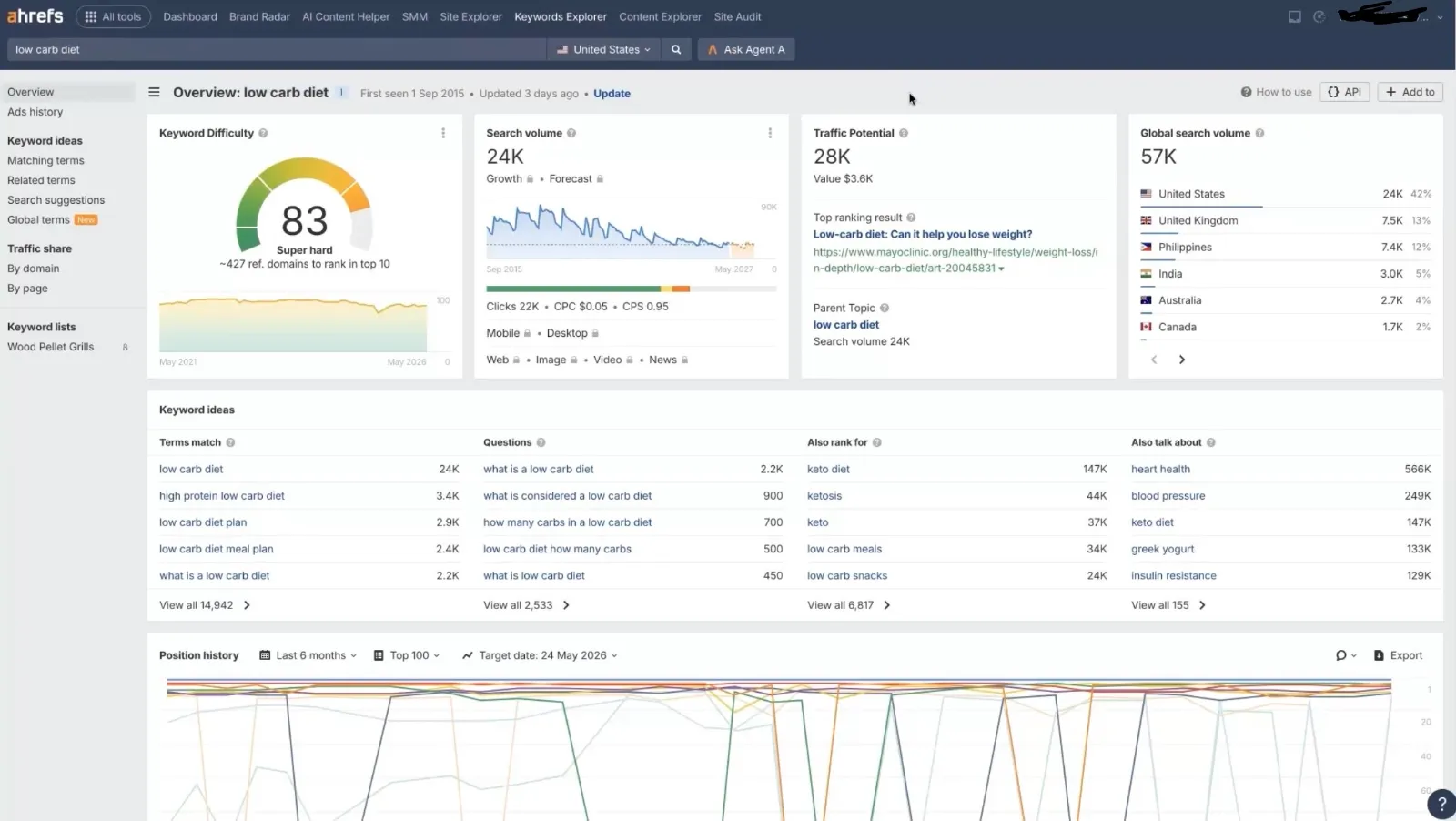
Keywords Explorer overview for “low carb diet”: KD 83 (“Super hard”), 24K US search volume, 28K Traffic Potential, 57K global volume.
The result was a useful reality check. The keyword had genuinely attractive demand — 24K US search volume, 28K Traffic Potential and 57K global volume — but a Keyword Difficulty of 83 and an Ahrefs estimate of roughly 427 referring domains needed to rank in the top 10 made it clear the keyword was extremely competitive. That 427 figure is Ahrefs’ own estimate based on current top-ranking pages — not a guarantee, and not a number that promises a top-10 ranking if you happen to match it.
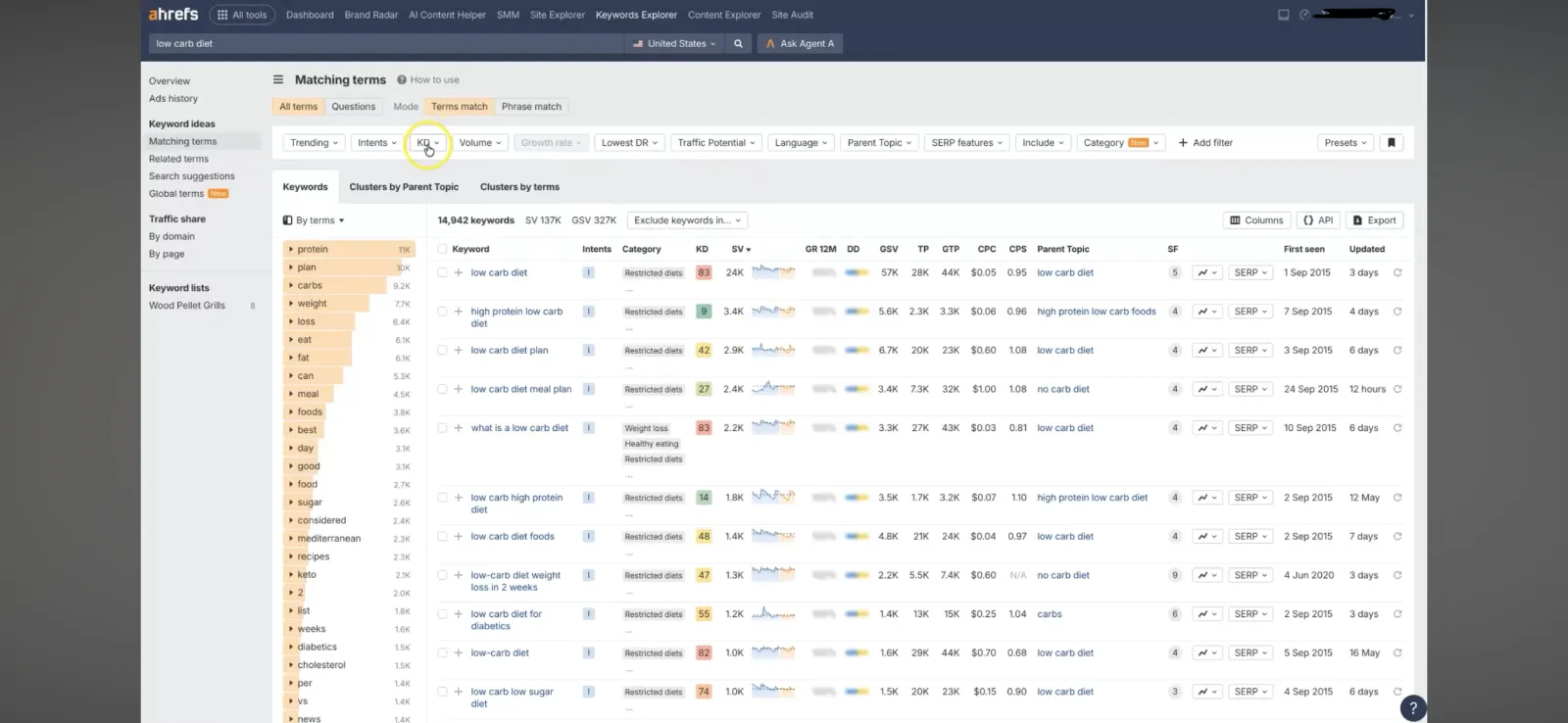
14,942 related keyword ideas for “low carb diet,” including “low carb diet plan” and “what is a low carb diet.”
Volume alone isn’t a good enough basis for choosing a keyword. The more reliable approach combines Keyword Difficulty, search volume, Traffic Potential, SERP intent and the pages actually competing for the term — and the related terms and questions reports then help map supporting content around that main topic, turning one seed keyword into a realistic content cluster instead of a single isolated page.
Hands-On Test — Site Audit
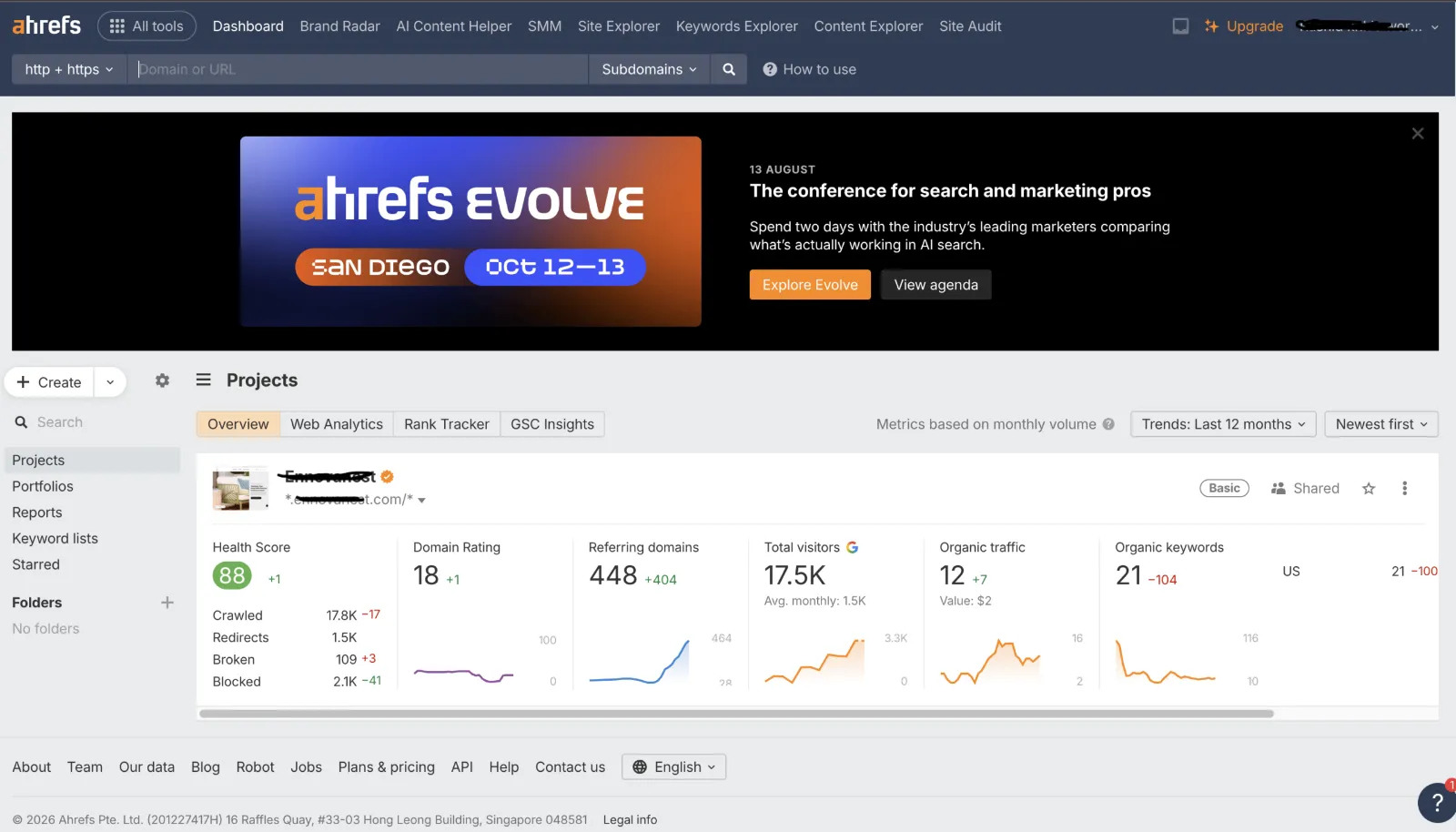
Site Audit project overview for a real client site: Health Score 88 (+1), 17.8K pages crawled, 1.5K redirects, 109 broken pages, 2.1K blocked.
Setup felt straightforward — the project dashboard loaded with a clear technical snapshot without much configuration required. The crawl itself covered a meaningful amount of the site: 17.8K pages crawled, 1.5K redirects, 109 broken pages and 2.1K blocked pages, alongside a Domain Rating of 18 and 448 referring domains for this project.
The Health Score of 88 (with a +1 improvement shown) was useful as a quick summary for understanding roughly where a site stands technically. It’s not, however, a complete SEO judgment on its own — a single number can’t tell you which issues actually matter for this specific site, and not every warning a crawler flags needs to be fixed blindly. Technical issues still need context and prioritization rather than a mechanical “fix everything” approach.
Brand Radar and AI Visibility
Brand Radar’s availability and capabilities vary by plan rather than being uniformly built into every tier. Custom tracked AI prompts are included from Lite upward — 5 prompts on Lite, up to 20 on Advanced, updated daily — enough to get a first read on whether your own brand shows up in AI answers. A separate Brand Radar AI add-on, starting from $199/month for a single-platform AI index, unlocks research across Ahrefs’ full 475M+ prompt database, including competitor brands — not just your own tracked prompts. The test below reflects that broader, add-on-level capability, using Ahrefs’ own brand as the tracked entity.
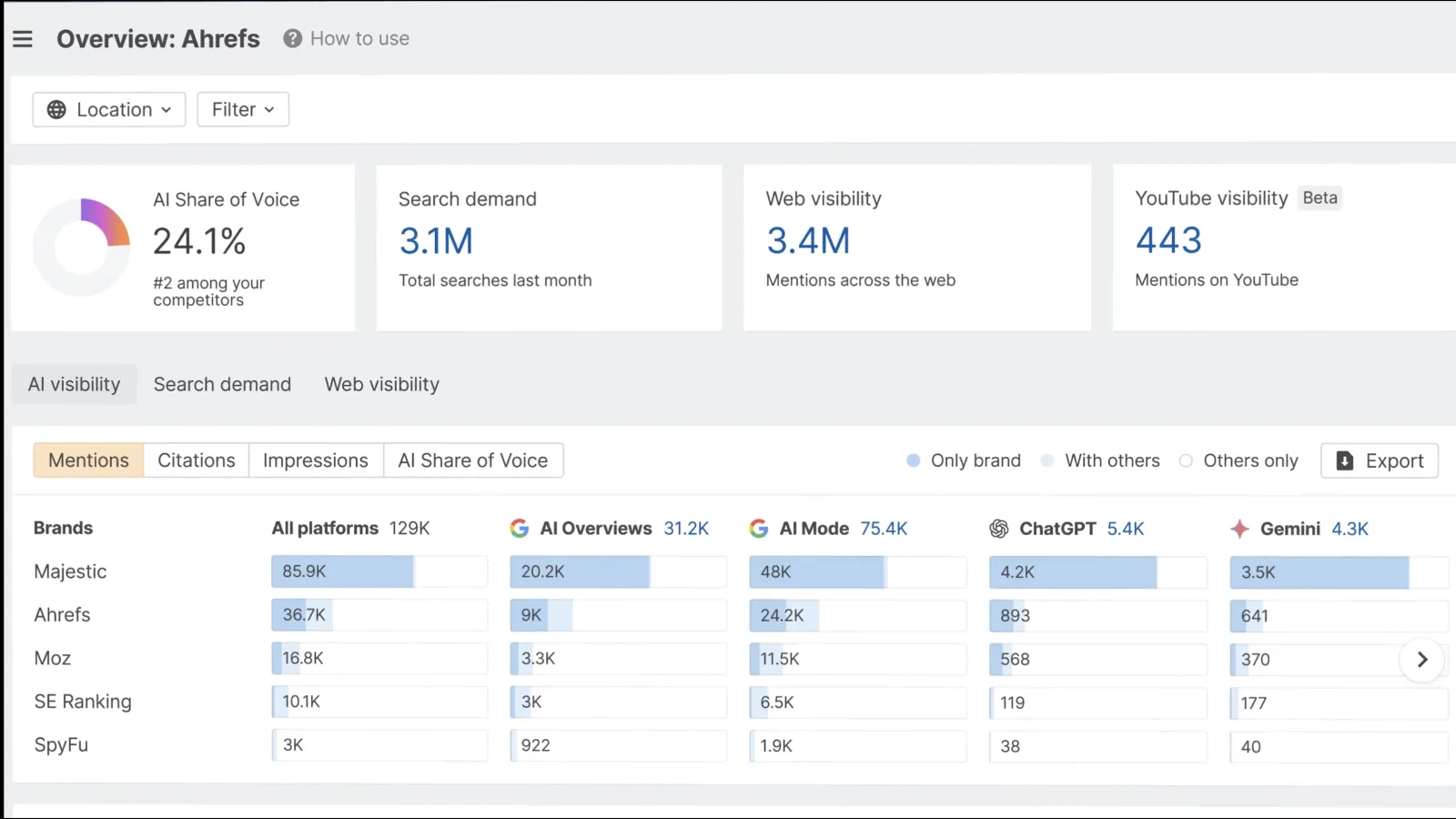
Brand Radar tracking “Ahrefs” itself: 24.1% AI Share of Voice, ranked #2 among the selected competitor set (Majestic, Moz, SE Ranking, SpyFu), with 3.1M search demand and 3.4M web visibility.
We treated the 24.1% Share of Voice as a directional competitive snapshot rather than absolute truth, since AI visibility isn’t a static metric the way traditional rankings are. In this selected dataset, Majestic had more mentions than Ahrefs — 85.9K versus 36.7K across the tracked platforms.
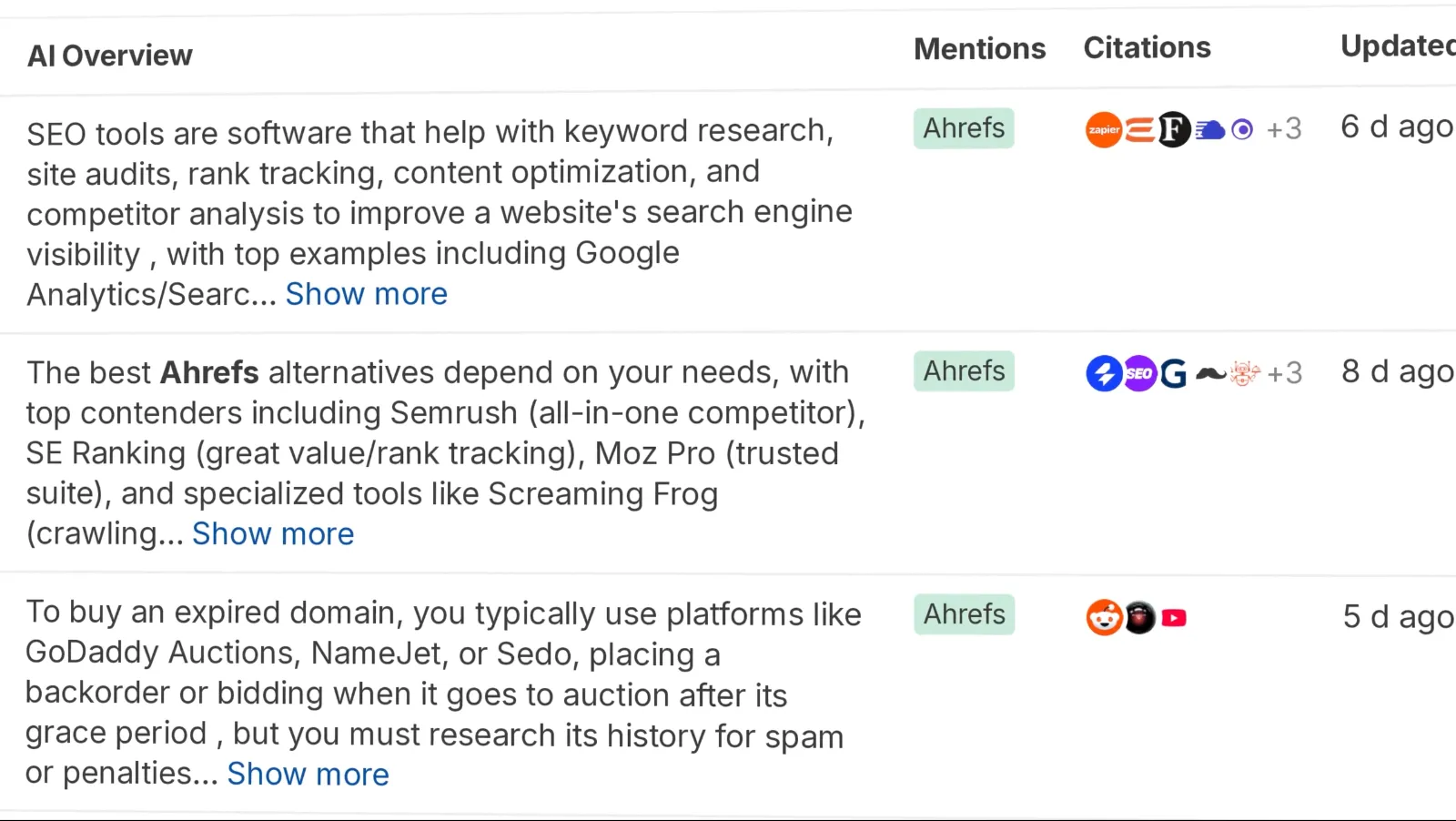
Individual AI Overview answers mentioning Ahrefs, with citation-source icons and update recency shown per result.
This is what moved the feature beyond a decorative dashboard: being able to inspect the specific queries where a brand appeared, and use that to guide content or GEO priorities. That said, simply appearing in this report doesn’t hand you a finished strategy — you still have to interpret the topics, prompts and citation patterns yourself.
Is the add-on worth it? If AI visibility is a genuine, ongoing priority for a client or your own brand, the $199/month starting price for Brand Radar AI can be justified by the competitive intelligence it surfaces. For a team doing conventional SEO work without an active AI-visibility mandate, it isn’t automatically necessary — the basic, bundled version may be enough to simply monitor your own presence.
Rank Tracker — Not Included in Our Hands-On Test
We ran into a network issue partway through testing and weren’t able to complete a hands-on Rank Tracker evaluation for this review. Rather than delay the article or improvise a verdict, we’re covering it here using Ahrefs’ own current documentation only — clearly separated from the hands-on sections above. We’re not scoring Rank Tracker in the breakdown below.
Per Ahrefs’ official plan comparison, Rank Tracker allowances scale with plan: 50 keywords on Starter, 750 on Lite, 2,000 on Standard, 5,000 on Advanced, and 10,000+ on Enterprise. Ahrefs currently lists weekly Rank Tracker updates across its subscription plans. It covers positions across 190+ locations on both desktop and mobile, along with competitor tracking and SERP-feature visibility. Because we haven’t used it directly for this review, we can’t speak to how it feels in practice, how reliable the updates are day to day, or how the reporting compares to competitors’ rank trackers.
What Ahrefs Can Replace — and What It Cannot
- A standalone backlink checker
- A separate keyword-research tool
- A basic competitor-research tool
- A basic technical-audit dashboard
- Some content-discovery/prospecting workflows
- A dedicated crawler for very large sites
- A full web-analytics platform
- An outreach CRM for link building
- A full PPC/social marketing suite
- Human SEO judgment and prioritization
Ahrefs Pros and Cons
- Deep backlink and competitor data — referring domains, anchors and Link Intersect gave genuinely actionable detail, not just totals.
- Keyword research that goes beyond volume — KD, Traffic Potential and SERP context together made for a stronger decision than volume alone.
- Content Gap and Link Intersect turn data into to-do items, not just numbers to read.
- Site Audit gives a fast, useful technical snapshot without heavy setup.
- Brand Radar is a real, current differentiator for teams that need AI-visibility data alongside traditional SEO.
- Genuinely premium pricing — and seats, Brand Radar AI, Content Kit and Project Boost all sit outside the base price.
- Large reports need filtering before they’re useful; browsing raw data doesn’t work well past a certain scale.
- No free trial — the $29 Starter plan is the only low-cost way to properly test it first.
- Not every AI suggestion is automatically relevant — Content Gap and Opportunities still need a manual relevance check.
- Rank Tracker wasn’t independently evaluated in this review, so we can’t personally vouch for its real-world reliability yet.
Transparent Score Breakdown
Each category below reflects what we actually found during testing, not a number chosen first and justified afterward. Rank Tracker is excluded since we didn’t hands-on test it. The overall figure below is our editorial judgment based on these category ratings, not a strict mathematical average — backlink/competitor research and workflow efficiency carried the most weight in that judgment, since they were the two factors that most influenced the renewal decision.
| Category | Score | Why |
|---|---|---|
| Backlink & competitor research | 4.8 | Deepest, most dependable area tested; Link Intersect and Content Gap turned data into real prospects. |
| Keyword research | 4.6 | KD, Traffic Potential and SERP context combine into genuinely better decisions than volume alone. |
| Site Audit | 4.3 | Straightforward setup and a useful snapshot; Health Score is helpful but not a complete judgment. |
| Ease of use | 4.0 | Approachable to start, but large reports demand active filtering rather than passive browsing. |
| Workflow efficiency | 4.7 | Multiple SEO tasks in one platform meant less jumping between tools during testing. |
| AI visibility (Brand Radar) | 4.1 | Useful for comparing visibility across the selected competitor set, but the results should be treated as directional rather than absolute. |
| Pricing / value | 3.8 | Data quality justifies the cost for heavy users; genuinely hard to justify for light, occasional use. |
| Overall (editorial score) | 4.5 | This is our overall editorial judgment based on the category ratings above, not a precise mathematical average. Backlink/competitor research and workflow efficiency influenced this score the most, reflecting what mattered most in the renewal decision below. |
Ahrefs vs Semrush vs SE Ranking vs Mangools
These comparisons combine our own hands-on Ahrefs testing with each competitor’s officially documented current features and pricing — we haven’t personally re-tested Semrush, SE Ranking or Mangools for this specific article, so treat those columns as documented positioning rather than fresh hands-on comparison.
| Job | Ahrefs | Semrush | SE Ranking | Mangools | Best choice when… |
|---|---|---|---|---|---|
| Backlink research | Very strong | Strong | Adequate | Basic | Ahrefs when link data depth is the priority |
| Keyword research | Excellent | Excellent | Solid, smaller DB | Good, simple | Ahrefs/Semrush for depth |
| Rank tracking | Weekly, not tested here | Good | Excellent, granular | Basic | SE Ranking for value + local depth |
| Site Audit | Strong | Strong | Strong | Limited | Tie between the big three |
| Broader marketing/PPC | Not a focus | Very strong | Limited | Not a focus | Semrush for a full marketing suite |
| Agency reporting | Limited | Good (paid add-on) | Excellent, white-label | Limited | SE Ranking for affordable white-label |
| AI visibility | Strong (add-on for depth) | Strong (AI Toolkit) | Good, integrated | Not offered | Ahrefs/Semrush for depth |
| Ease of use | Moderate learning curve | Feature-dense | Approachable | Very simple | Mangools for simplicity |
| Budget suitability | Premium | Premium | Budget-friendly | Most affordable | Mangools/SE Ranking on a budget |
Choose Ahrefs when backlink intelligence and deep SEO research are the priority. Choose Semrush when a broader marketing/PPC suite is needed alongside SEO. Choose SE Ranking when value, rank tracking and agency reporting matter more than maximum data depth — see our full SE Ranking review. Choose Mangools when simplicity and lower cost matter more than data depth.
Who Should Use Ahrefs — and Who Shouldn’t?
- Professional SEOs, agencies and in-house teams — strong fit. Backlink depth, competitor research and keyword analysis are exactly where Ahrefs earns its price.
- Serious freelancers — strong fit, starting on Lite or Standard depending on project volume.
- Link-building and competitor-research specialists — strong fit; this is Ahrefs’ clearest area of strength.
- Complete beginners and hobby bloggers — weak fit. The depth here is more than most casual use cases need, and the cost is hard to justify against occasional use.
- Very small businesses — weak-to-moderate fit; the $29 Starter plan or Ahrefs Free may cover genuine needs without the full subscription.
- Teams needing a broad PPC/social marketing suite — weak fit; Ahrefs isn’t built for that, and Semrush is the more natural choice.
- Anyone unwilling to commit before testing properly — worth noting clearly: there’s no free trial, so budget for at least the Starter plan to evaluate data quality first.
Final Verdict: Is Ahrefs Worth It?
Ahrefs is worth considering when deep backlink intelligence, competitor research, keyword analysis and content discovery are central to how you work. It becomes harder to justify when you only need occasional keyword research, basic rank tracking, or a simpler, lower-cost SEO tool.
- Buy/renew if your workflow depends heavily on SEO research, competitor analysis, backlinks and content discovery.
- Consider an alternative if you need broader marketing tools, tighter budget fit, or simpler rank tracking as your main job.
- Skip it if you only need occasional keyword research or basic technical checks.
We would renew Ahrefs for a workflow built around heavy SEO research, competitor analysis, backlinks and content discovery. It would be harder to justify for occasional keyword research alone. The biggest reason to choose it is data depth in backlink and competitor research; the biggest reason not to is the combination of premium pricing and the learning curve required to get full value from it.
Frequently Asked Questions
Is Ahrefs worth the money in 2026?
For professional SEOs, agencies and in-house teams doing heavy backlink and competitor research, yes — the data depth justifies the cost. For occasional keyword research or basic rank tracking, a cheaper tool is likely a better fit.
Which Ahrefs plan is best?
Lite ($129/mo) suits solo users on a single project. Standard ($249/mo) is the realistic starting point for agencies and small teams, since it adds Content Explorer and considerably higher limits. Advanced ($449/mo) fits larger in-house teams. Prices verified on ahrefs.com/pricing, 27 August 2026.
Does Ahrefs offer a free trial?
No. Ahrefs’ own pricing FAQ confirms it doesn’t run trials or discounts. The free Ahrefs Free plan (limited to your own verified sites) or the $29/month Starter plan are the lowest-cost ways to test it first.
Is Ahrefs suitable for beginners?
It’s usable for beginners, but the depth of data means there’s a real learning curve before reports become genuinely useful rather than overwhelming. Beginners on a budget may get more immediate value from a simpler tool.
Is Ahrefs better than Semrush?
Ahrefs generally leads on backlink data depth; Semrush offers a broader marketing suite including PPC and social tools. The better choice depends on whether backlink intelligence or all-in-one marketing breadth matters more to you.
Is Ahrefs good for agencies?
Yes, particularly on Standard or Advanced for the higher project counts and seats. Agencies should budget for additional seats ($40–80/mo each depending on tier) and any Project Boost add-ons separately from the base subscription.
Is Ahrefs good for ecommerce SEO?
Yes, particularly for established ecommerce stores and teams that need product and category keyword research, competitor backlink analysis, content-gap discovery and technical site audits. However, smaller stores that only need occasional keyword research may find the full plans difficult to justify and may be better served by the Starter plan or a lower-cost alternative.
How reliable is Ahrefs’ backlink data?
In our testing, backlink and referring-domain data was detailed and dependable for competitor and link-profile analysis. It’s still not a substitute for manually checking whether individual links are genuinely relevant and high-quality.
Is Ahrefs’ Keyword Difficulty accurate?
KD is a useful signal but shouldn’t be used alone. In our test, a KD of 83 combined with an estimated ~427 referring domains needed for a top-10 ranking gave a much clearer competitive picture than the KD score by itself.
What is the best cheaper alternative to Ahrefs?
SE Ranking and Mangools are the most common lower-cost alternatives. SE Ranking generally offers a lower-cost option for rank tracking and reporting; Mangools trades data depth for simplicity and an even lower cost.
Does Ahrefs track AI visibility?
Yes, through Brand Radar. A basic version tracking a small number of your own prompts is included from Lite upward. A separate Brand Radar AI add-on, starting from $199/month for a single-platform AI index, unlocks broader research across Ahrefs’ full prompt database, including competitor brands.