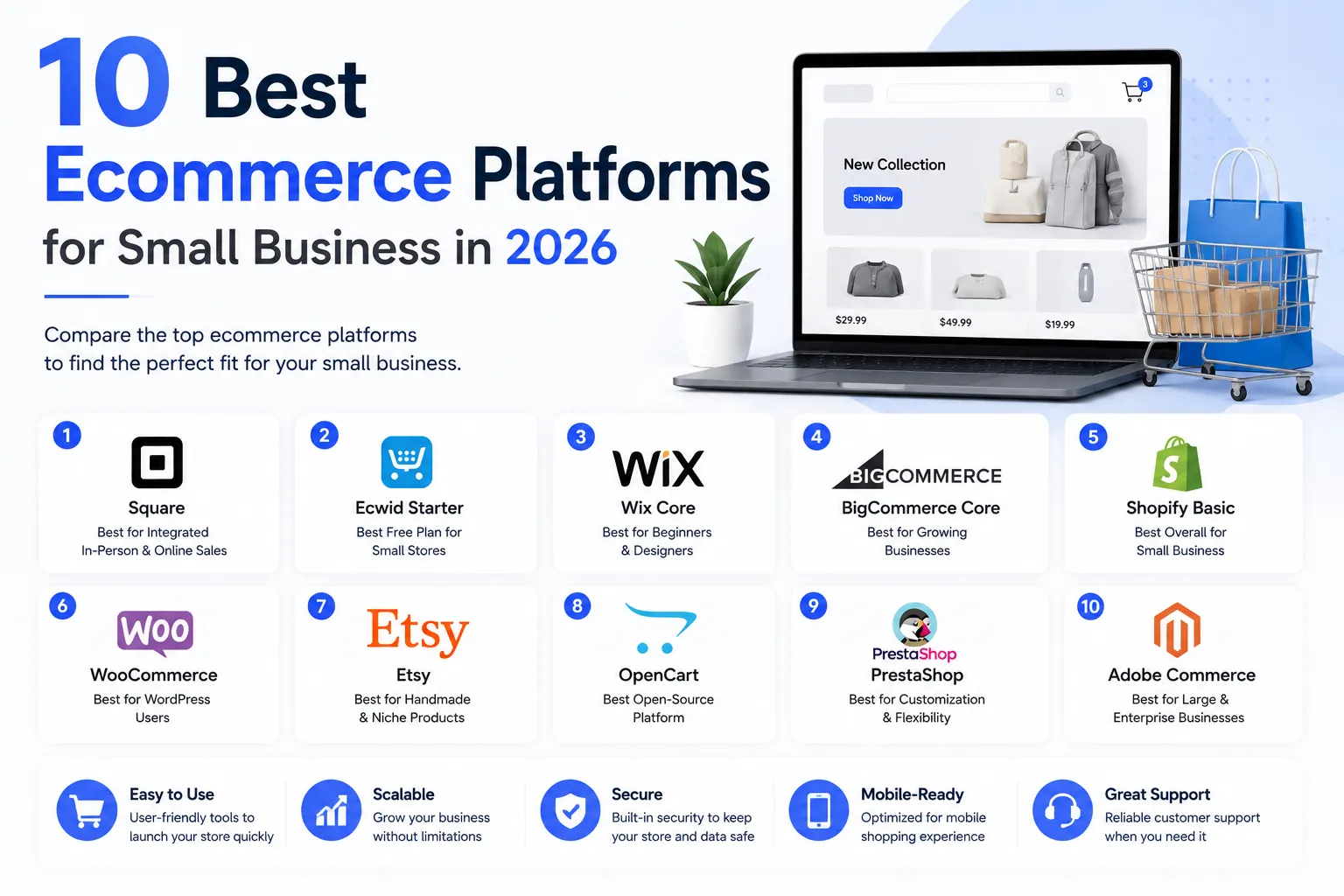
Choosing the best ecommerce platforms for your small business shouldn’t mean guessing between big names. This guide compares the best ecommerce platforms in 2026 across pricing, ease of use, and real transaction costs — because the sticker price rarely tells the full story. Whether you’re launching your first store, running a WordPress site, or selling handmade goods, these are the best ecommerce platforms for small business budgets, with every price verified from official pricing pages this month.
Quick Picks:
🏆 Best overall: Shopify — the most complete platform for serious sellers
💻 Best for WordPress: WooCommerce — free core plugin, full control
🎨 Best design-first builder: Squarespace — for brands where aesthetics sell
🆓 Best zero-cost start: Square Online — no monthly fee, pay only when you sell
How we evaluated: all pricing verified from official pricing pages as of August 2026, combined with user sentiment from G2, Capterra, and Reddit — no fabricated testing claims, ever.
How to Choose an Ecommerce Platform for Your Small Business
The verdict: match the platform to your starting point, not your five-year plan — you can always migrate once you outgrow it.
Every ecommerce platform makes trade-offs between three things: ease of use, cost, and control. Hosted platforms like Shopify and BigCommerce handle security and updates for you, but you pay a subscription. Self-hosted options like WooCommerce are free at the core, but you own the maintenance.
Before picking, answer three questions. First, do you already have a website, or are you starting from scratch? Adding a store to an existing WordPress or Wix site favors WooCommerce or Ecwid; starting fresh favors Shopify or Squarespace. Second, how technical are you? Hosted platforms need zero coding; WooCommerce rewards comfort with WordPress. Third, what’s your product type — physical goods, digital downloads, handmade items, or services all shift the best pick.
Additionally, watch transaction fees as closely as the monthly price. A platform that’s $10 cheaper per month but charges 2% more per sale can cost you far more once you’re actually selling. We break down the real numbers for each platform below.
Quick Comparison: Best Ecommerce Platforms at a Glance
| Platform | Best For | Starting Price (Aug 2026) | Transaction Fees |
|---|---|---|---|
| Shopify | All-around power | $39/mo ($29 annual) | 0% with Shopify Payments; 2% otherwise |
| WooCommerce | WordPress control | Free core (hosting $20–200/mo) | 0% platform fee; payment processor fees apply |
| BigCommerce | No transaction fees at scale | $39/mo ($29 annual) | 0% platform fee always |
| Wix | Beginners | $29/mo (Core, first ecommerce tier) | 0% platform fee; processor fees apply |
| Squarespace | Design-first brands | ~$19–29/mo (varies by region/promo) | 0% on Core plan and above |
| Etsy | Handmade & vintage | No subscription (marketplace fees apply) | 6.5% + $0.20 listing + processing |
| Square Online | Zero-cost start | Free ($0/mo) | 3.3% + 30¢ online (Free plan) |
| Ecwid by Lightspeed | Adding a store to an existing site | $5/mo (Starter, 10 products) | 0% platform fee, any plan |
1. Shopify — Best Overall Ecommerce Platform
Verdict: still the most complete, reliable platform for anyone serious about selling online — the app ecosystem alone justifies the price for most stores.
Shopify restructured its plans in 2026. As of August 2026, Basic costs $39/month ($29/month billed annually), Grow (formerly the mid-tier “Shopify” plan) is $105/month ($79 annual), and Advanced runs $399/month ($299 annual). Shopify Plus, built for high-volume merchants, starts at $2,300/month on a multi-year contract.
Every plan includes unlimited products, secure hosting, a full checkout, and Shopify’s AI assistant Sidekick. Using Shopify Payments eliminates the platform’s transaction fee entirely; third-party gateways incur a 0.5–2% surcharge depending on your plan. For a deeper breakdown of real-world costs, our full Shopify review 2026 covers themes, apps, and what stores actually spend per month.
Who it’s for: anyone starting fresh who wants zero technical setup and the largest app ecosystem in ecommerce.
👉 Start your free Shopify trial
2. WooCommerce — Best for WordPress Control
Verdict: free to install, but budget $20–200/month in real costs — the trade-off is complete ownership of your store.
WooCommerce is a free WordPress plugin, not a hosted platform — you supply your own hosting and manage updates yourself. The core software costs nothing, but realistic monthly costs land between $20 and $200 once hosting, a premium theme, and a few extensions are factored in, based on typical setups.
The payoff is control: no platform transaction fees, full access to WordPress’s plugin ecosystem, and complete ownership of your data. We covered the full cost breakdown, including hosting tiers and must-have extensions, in our WooCommerce review 2026. If you’re torn between the two giants, our WooCommerce vs Shopify 2026 comparison walks through the decision in detail.
Who it’s for: owners already comfortable with WordPress who want to avoid recurring platform fees long-term.
3. BigCommerce — Best for Avoiding Transaction Fees
Verdict: the only major platform with zero built-in transaction fees on every plan — a real advantage as your sales volume grows.
BigCommerce renamed its plans in 2026: Core costs $39/month ($29 annual) for up to $30K in trailing annual sales, Growth is $105/month ($79 annual) up to $100K, and Scale runs $399/month ($299 annual). Performance, the enterprise tier, starts at $1,499/month.
Unlike Shopify, BigCommerce charges no platform transaction fee on any tier — you only pay your payment processor’s standard rate. However, plans auto-upgrade based on your trailing 12-month sales, so growing stores should budget for the next tier ahead of time. BigCommerce’s native B2B tools also make it a strong pick for the “best b2b ecommerce platforms” search — Scale and Performance both include advanced customer segmentation and wholesale pricing.
Who it’s for: growing stores that want to avoid transaction fees, and B2B sellers needing wholesale pricing tools.
4. Wix — Best for Absolute Beginners
Verdict: the gentlest learning curve of any platform on this list, with ecommerce unlocked from the first paid tier.
Wix’s Core plan, the first tier that enables selling, costs $29/month. Business at $39/month adds advanced shipping and automated tax calculation, while Business Elite ($159/month) targets larger catalogs needing unlimited storage. As of August 2026, Wix’s drag-and-drop editor and AI-assisted site setup remain the fastest way to launch a store with zero design experience.
The trade-off: Wix’s ecommerce feature depth doesn’t match Shopify or BigCommerce at scale, and switching templates after launch can be limited. For simple catalogs under a few hundred products, that ceiling rarely matters.
Who it’s for: first-time sellers who want a visual builder and don’t need advanced ecommerce features yet.
5. Squarespace — Best for Design-First Brands
Verdict: unmatched template design quality — the platform of choice when your brand’s visual presentation is the selling point.
Squarespace restructured its plans to Basic, Core, Plus, and Advanced in late 2025. As of August 2026, pricing runs roughly $19–29/month for Basic and Core when billed annually, scaling up to Advanced for high-volume stores; Squarespace’s pricing is geolocated and occasionally promotional, so confirm exact current figures at squarespace.com/pricing before publishing final numbers. All paid plans support selling products or services, though advanced commerce tools like abandoned cart recovery and carrier-calculated shipping are gated to higher tiers.
Online store transaction fees drop to 0% from the Core plan upward — only Basic carries a small platform fee. Photographers, boutique brands, and service businesses consistently favor Squarespace for its template quality over raw ecommerce feature count.
Who it’s for: design-conscious brands, photographers, and creators selling a smaller, curated catalog.
6. Etsy — Best for Handmade and Vintage Sellers
Verdict: not a platform you build a store on — it’s a marketplace with built-in buyer traffic, which changes the entire cost equation.
Etsy charges no monthly subscription for a basic shop. Instead, sellers pay a $0.20 listing fee per item, a 6.5% transaction fee on the total sale (including shipping), and a 3% + $0.25 payment processing fee for US sellers, as of August 2026. Sellers earning over $10,000 annually are automatically enrolled in Offsite Ads, an additional 12–15% fee on attributed sales.
The math is different from a hosted store: you’re trading a higher per-sale cut for access to Etsy’s existing buyer base, which is exactly why so many searches compare “Etsy or Shopify” — it depends whether you want built-in discovery or full brand control.
Who it’s for: handmade goods, vintage items, and craft supply sellers who want built-in buyer traffic from day one.
7. Square Online — Best Zero-Cost Start
Verdict: the only platform on this list with a genuinely free tier that includes a real online store, not just a demo.
Square restructured its plans in October 2025 into Free, Plus, and Premium. As of August 2026, the Free plan costs $0/month and includes a full online store with a 3.3% + 30¢ processing fee on online card payments. Plus runs $49/month per location with a lower 2.9% + 30¢ rate, and Premium is $149/month with the lowest available rate.
Square’s biggest strength is unifying online and in-person sales — inventory and customer data sync automatically if you also use Square’s point-of-sale hardware. That makes it a natural fit for sellers who split time between markets, pop-ups, and an online store.
Who it’s for: businesses that sell both in person and online, and anyone testing an idea before committing to a subscription.
8. Ecwid by Lightspeed — Best for Adding a Store to an Existing Site
Verdict: the easiest way to bolt a real store onto a site you already have — and every plan has zero transaction fees.
Ecwid (now part of Lightspeed) replaced its old free tier with a $5/month Starter plan (up to 10 products) in March 2026. Venture runs $35/month ($29 annual) for 100 products, Business is $65/month ($49 annual) for 2,500 products, and Unlimited costs $149/month ($119 annual). No plan charges a platform transaction fee.
Unlike the other platforms here, Ecwid isn’t a standalone website — it’s a shopping cart widget you embed into WordPress, Wix, Squarespace, or almost any existing site, plus social channels and marketplaces. That makes it the natural answer for “best headless ecommerce platforms” searches: your content lives on your existing site, and Ecwid handles just the cart and checkout.
Who it’s for: bloggers, creators, and existing site owners who want to add selling without rebuilding their site.
Best Ecommerce Platforms for Small Business Budgets
If budget is the deciding factor, the order shifts. Square Online’s free tier costs nothing until you make a sale, making it the safest starting point for testing an idea. Ecwid’s $5 Starter plan is the cheapest genuine store subscription on this list, though the 10-product cap suits a narrow catalog only.
For a full-featured store without an enterprise price tag, Shopify Basic and BigCommerce Core both land at $39/month ($29 billed annually) — nearly identical pricing with different strengths: Shopify wins on apps, BigCommerce wins on zero transaction fees. Therefore, if you’re deciding between the two, the transaction-fee math matters more than the sticker price once you’re doing real volume.
Whichever platform you choose, pair it with solid on-page SEO — our guide to the best SEO tools for small business covers the keyword research and site audit tools that help a new store actually get found.
What Reddit Users Say About Ecommerce Platforms
Ecommerce platform threads are some of the most active on Reddit. Here’s the recurring sentiment:
- A common sentiment on r/ecommerce is that Shopify’s app ecosystem is both its biggest strength and its most common cost complaint — small monthly app fees add up faster than the base plan.
- Frequent feedback on r/shopify suggests most new stores stay on the entry-level plan for at least a year before upgrading pays off.
- Users on r/WooCommerce regularly note that hosting quality matters more than the plugin choice — cheap hosting is the most common source of slow WooCommerce stores.
- A recurring theme on r/Etsy is that sellers underestimate the combined effect of the 6.5% transaction fee plus payment processing until their first payout.
- Common sentiment on r/smallbusiness favors starting on a free or near-free tier (Square Online, Ecwid Starter) to validate demand before committing to a paid ecommerce plan.
Frequently Asked Questions
Which platform is best for ecommerce?
Shopify is the best overall pick for most small businesses thanks to its app ecosystem and ease of use. However, “best” depends on context: WooCommerce wins for WordPress owners wanting full control, and BigCommerce wins if avoiding transaction fees matters more than app selection.
What are the top 10 ecommerce platforms?
Based on 2026 pricing, features, and adoption, the leading platforms are Shopify, WooCommerce, BigCommerce, Wix, Squarespace, Etsy, Square Online, and Ecwid by Lightspeed — the eight compared in this guide — followed by enterprise options like Adobe Commerce for large-scale operations.
What is the cheapest ecommerce platform?
Square Online’s Free plan costs $0/month, making it technically the cheapest — you only pay processing fees per sale. For a genuine paid subscription, Ecwid’s Starter plan at $5/month is the lowest-cost option, though it caps out at 10 products.
Is eCommerce still worth it in 2026?
Yes — global ecommerce continues to grow, and platforms have gotten cheaper and easier to launch on. The bigger factor than “is it worth it” is choosing a platform that matches your product type and budget from the start, since switching platforms later means re-migrating products, SEO, and customer data. If you’re leaning toward Shopify, our break-even check shows whether Shopify is worth it for your order volume.
Is it better to have an Etsy or Shopify store?
Etsy gives you built-in buyer traffic but takes a larger cut per sale (roughly 9.5%+ combined fees) and limits branding. Shopify gives you full brand control and lower per-sale costs once you have your own traffic, but you must drive that traffic yourself. Many sellers use both — Etsy for discovery, Shopify for the long-term brand.
Final Verdict: Which Ecommerce Platform Should You Choose?
| Your Situation | Our Pick | Starting Cost |
|---|---|---|
| Testing an idea, $0 budget | Square Online Free | $0/mo + processing fees |
| Adding a cart to existing site | Ecwid Starter | $5/mo |
| First real store, beginner | Wix Core | $29/mo |
| Full-featured, no transaction fees | BigCommerce Core | $39/mo ($29 annual) |
| All-around best app ecosystem | Shopify Basic | $39/mo ($29 annual) |
| WordPress owner, full control | WooCommerce | Free core + $20–200/mo hosting |
| Handmade goods, built-in traffic | Etsy | No subscription, per-sale fees |
In short: match the platform to where you are today, not where you hope to be in three years. Start with Square Online or Ecwid if you’re testing demand, move to Shopify, BigCommerce, or WooCommerce once you’re ready to build a real brand, and revisit this list once your sales volume actually justifies an upgrade.
👉 Ready to launch? Start your free Shopify trial — or read our full Shopify review 2026 and WooCommerce review 2026 to compare the two most popular options in depth.