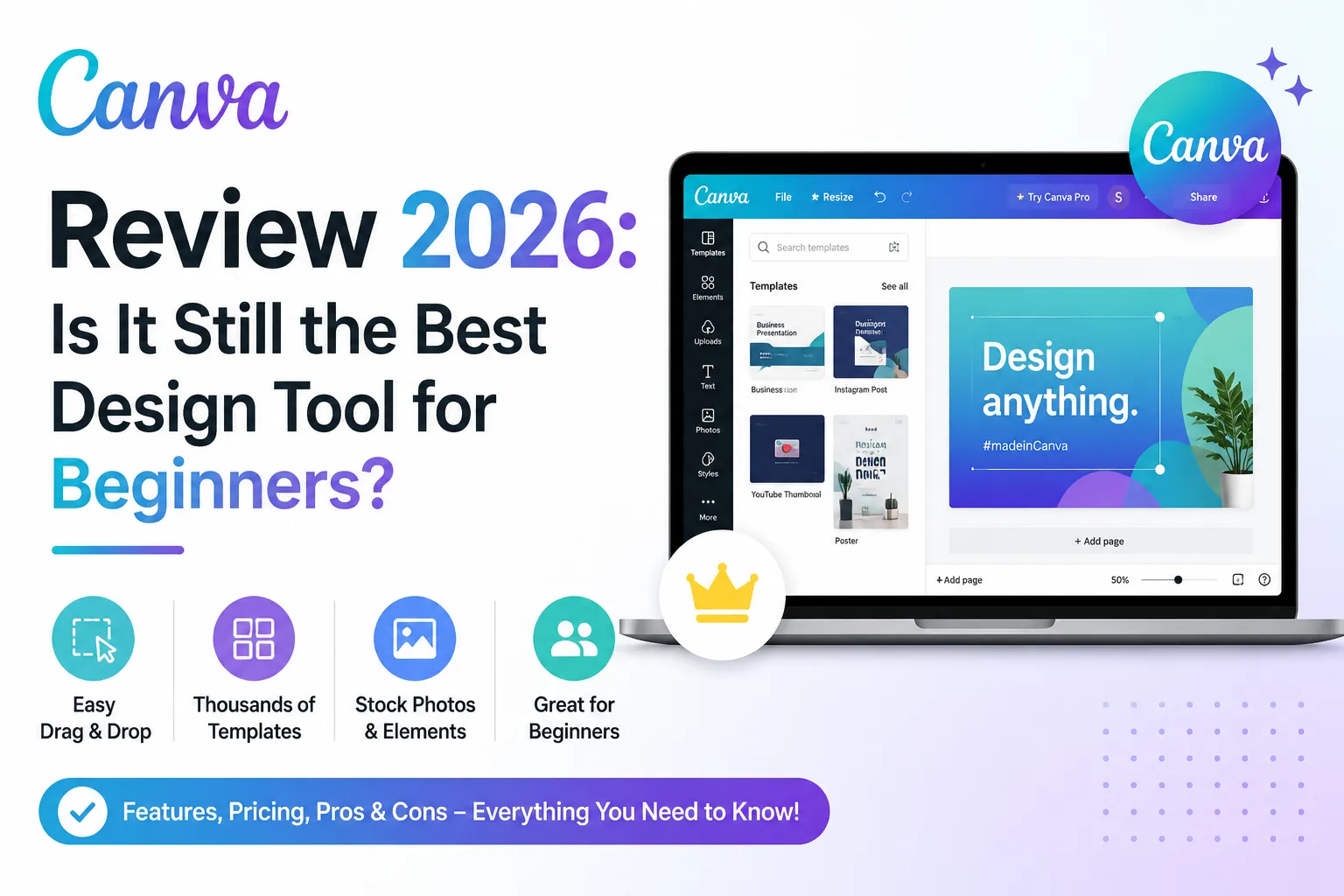
In this Canva review, we found Canva to still be the best design tool in 2026 for beginners, freelancers, and small businesses. The free plan remains genuinely useful, while Canva Pro unlocks premium assets and AI-powered design tools.
Is Canva still the best design tool in 2026? This Canva review answers exactly that question. We break down Canva’s features, pricing, free vs Pro plans, website builder quality, and real user feedback so you can decide if this Canva review confirms it fits your business needs — or if a cheaper alternative wins in 2026.
Furthermore, this review of Canva covers every angle that matters. Specifically, we analyze the mobile app, Canva Pro pricing, the website builder (110 monthly searches alone), resume templates, print quality, and aggregated Reddit feedback. Consequently, by the end you’ll know whether Canva is worth your time and money in 2026.
Additionally, this canva com review focuses on real-world value, not hype. Notably, Canva now powers 170+ million users worldwide and competes directly with Adobe Express, Figma, and VistaCreate. Therefore, the right question isn’t whether Canva is good — it’s whether Canva is the best fit for your specific needs.
1. What is Canva? — Quick Overview
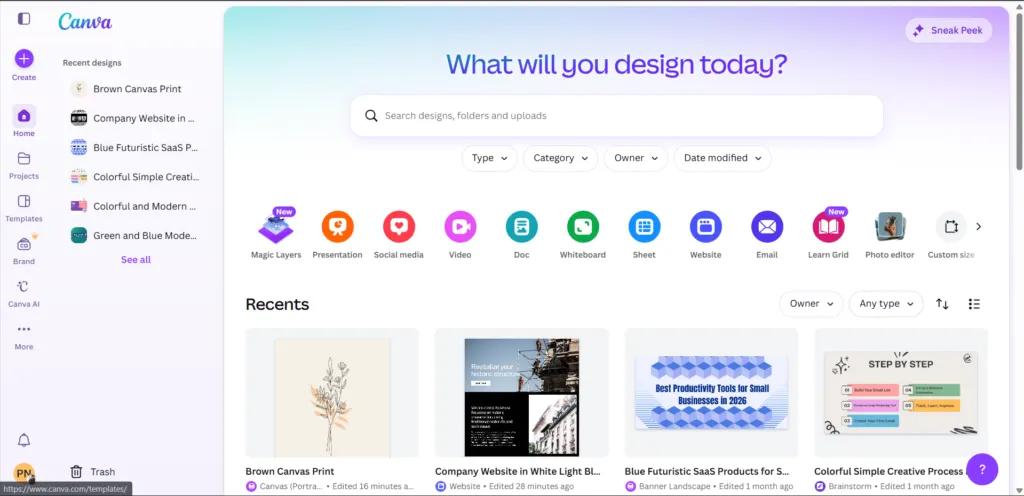
Canva launched in 2013 in Sydney, Australia. Melanie Perkins, Cliff Obrecht, and Cameron Adams built it with one goal: make design accessible to non-designers.
Today, this canva software review covers a platform used by 170+ million people worldwide. Specifically, Canva now offers templates for social media, presentations, videos, websites, resumes, print products, and more. As a result, it has become the default design tool for small businesses globally.
Moreover, this canva com review notes one major 2026 development. Notably, Canva expanded heavily into AI with Magic Studio — including Magic Design, Magic Expand, Magic Write, and the new background remover. Consequently, the platform now competes with both Adobe and standalone AI image tools.
- Drag-and-Drop Editor — design without any technical skills required
- 250,000+ Templates on Free plan — social media, docs, presentations, more
- Magic Studio AI — text-to-image, magic resize, background remover
- Website Builder — free websites with optional custom domain
- Mobile App — full design on iOS and Android
- Print Service — business cards, photo books, posters delivered
2. Canva Review 2026 — Honest Analysis
Based on aggregated user reviews across G2, Capterra, and Reddit, the canva review consensus in 2026 is overwhelmingly positive. Specifically, Canva scores 4.7/5 on G2 and 4.7/5 on Capterra across thousands of reviews. As a result, it remains the most-loved design tool for non-designers.
Furthermore, the review of Canva from real users highlights one consistent theme: ease of use. Importantly, most beginners can create a professional-looking design within 10 minutes of signing up. Therefore, the learning curve is genuinely the shortest in the design tool industry.
However, Canva isn’t perfect. Notably, professional designers consistently criticize Canva for limited typography control, no advanced layer management, and the inability to edit at the pixel level. Consequently, the platform is built for speed and accessibility — not precision.
In short, Canva works brilliantly if you need ‘good enough’ design fast. However, if you need pixel-perfect output for branding agencies or print production, dedicated tools like Adobe Illustrator or Figma remain superior.
Canva Free vs Pro — Comparison Table
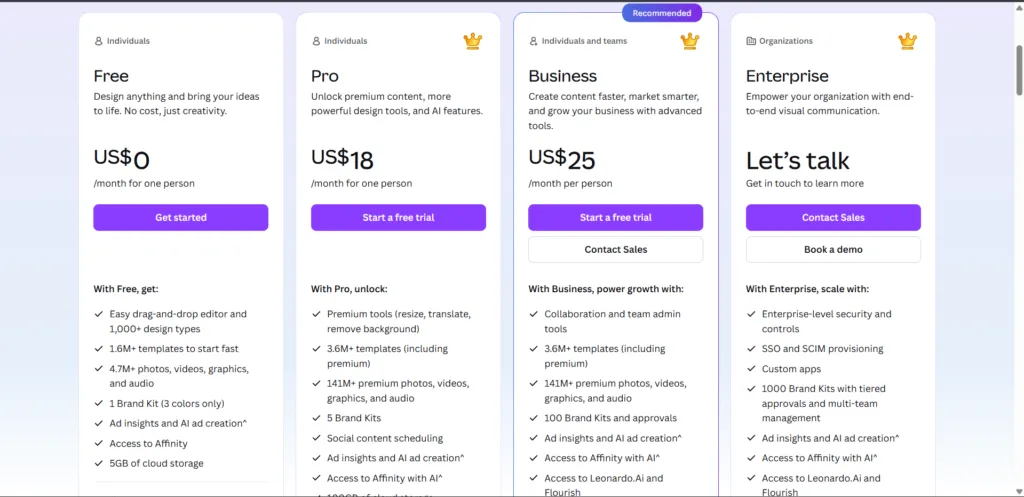
| Feature | Free Plan | Canva Pro ($18/mo) |
| Templates | 250,000+ | 1 million+ premium |
| Stock Photos | Limited free | 140M+ premium assets |
| Storage | 5 GB | 1 TB |
| Brand Kits | Basic (1) | Unlimited |
| Background Remover | ❌ Not included | ✅ Unlimited use |
| Magic Studio AI | Limited credits | 500 monthly credits |
| Magic Resize | ❌ Not included | ✅ One-click resize |
| Schedule Posts | ❌ Not included | ✅ 9 social platforms |
| Custom Fonts | ❌ Not allowed | ✅ Upload your own |
| Best For | Casual users, students | Freelancers, creators |
| Quick verdict: The Canva free review is honest — Canva’s free plan is genuinely useful, with 250,000+ templates and no watermarks. However, if you create more than 5 designs per month, the Magic AI tools and Brand Kit on Pro pay for themselves quickly. Therefore, start free and upgrade only when you hit friction. |
Pair Canva with the right business stack. Our guide to best productivity tools for small businesses covers tools that work great alongside Canva for daily operations.
3. Canva App Review — How Good Is the Mobile App?
This canva app review covers what 4.9-star ratings on iOS and 4.6-star ratings on Android already suggest. Specifically, the Canva mobile app is one of the best-designed creative apps in any category. Furthermore, it offers genuine feature parity with the desktop version — not a stripped-down experience.
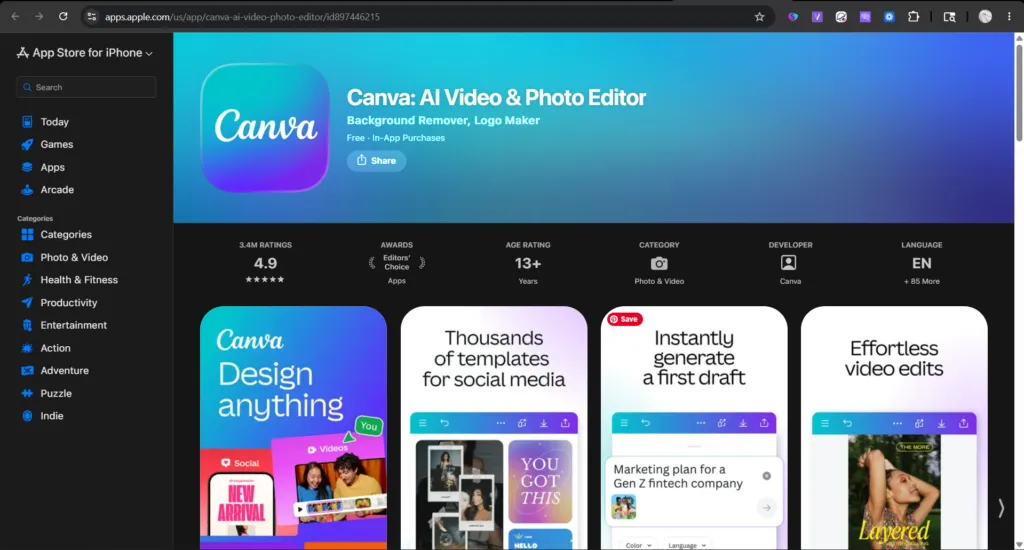
Notably, the mobile app handles full design workflows. For example, social media managers regularly create Instagram posts, stories, and Reels directly from their phones. As a result, content creators can design and publish in under 10 minutes without ever touching a laptop.
However, the canva app review also reveals real limitations. Importantly, complex multi-page designs (presentations, ebooks, print products) are still easier on desktop. Therefore, treat the app as your daily-use tool for social content, not for heavy design work.
Canva App vs Desktop — Which Is Better?
| Use Case | Mobile App | Desktop |
| Social Media Posts | ✅ Best | Good |
| Instagram Stories/Reels | ✅ Best | Limited |
| Presentations | Limited | ✅ Best |
| Multi-Page Designs | Hard | ✅ Best |
| Magic Studio AI | ✅ Full access | ✅ Full access |
| Brand Kit Access | ✅ Full sync | ✅ Full sync |
| Offline Editing | Limited | ✅ Better |
My honest take: For social media work, the canva app review verdict is genuinely impressive — it beats every competitor app. However, for heavy design work like presentations or website building, switch to desktop. Consequently, most users will need both.
4. Canva Pro Review — Is the Paid Plan Worth It?
This canva pro review answers the question every casual user eventually asks: is $18/month actually worth it? Specifically, the upgrade unlocks 140M+ premium assets, unlimited brand kits, Magic Studio AI tools, background remover, and 1TB of storage. Therefore, the value depends entirely on how often you design.
Furthermore, the canva brand kit review highlights one of Pro’s most underrated features. Importantly, the Brand Kit lets you save logos, fonts, color palettes, and templates in one place. As a result, every design starts on-brand automatically — a huge time-saver for freelancers and agencies.
Additionally, the canva enterprise review reveals one critical fact. Notably, Enterprise pricing is custom (typically $20K-$50K/year for 25+ seats) and adds SSO, SAML, IP allowlisting, and the Connect API. Consequently, Enterprise is built for large organizations needing advanced security — not for small businesses.
Canva Free vs Pro vs Enterprise — Pricing Table
| Plan | Monthly Price | Best For |
| Free | $0 | Casual users, students |
| Pro ⭐ | $18/mo ($144/yr) | Freelancers, solopreneurs |
| Teams/Business | $10/user/mo (3 min) | Small teams of 3+ |
| Enterprise | Custom (contact sales) | Large orgs (25+ seats) |
| Education | Free (verified) | K-12 teachers/students |
| Nonprofits | Free (verified) | Registered nonprofits |
Pro tip: Annual billing on Canva Pro saves roughly $60/year ($120/year vs $180 if billed monthly). Therefore, if you’re committed to using Canva, annual is the obvious choice. Additionally, K-12 teachers, students, and nonprofits qualify for free Pro access — apply via the Canva for Good program before paying.
5. Canva Website Review — Can It Build Real Websites?
This canva website review is the most important section of this article — and for good reason. Specifically, ‘canva website review’ attracts 110 monthly searches because people genuinely want to know: can Canva replace WordPress, Wix, or Squarespace? Therefore, let’s answer that directly with research-based facts.
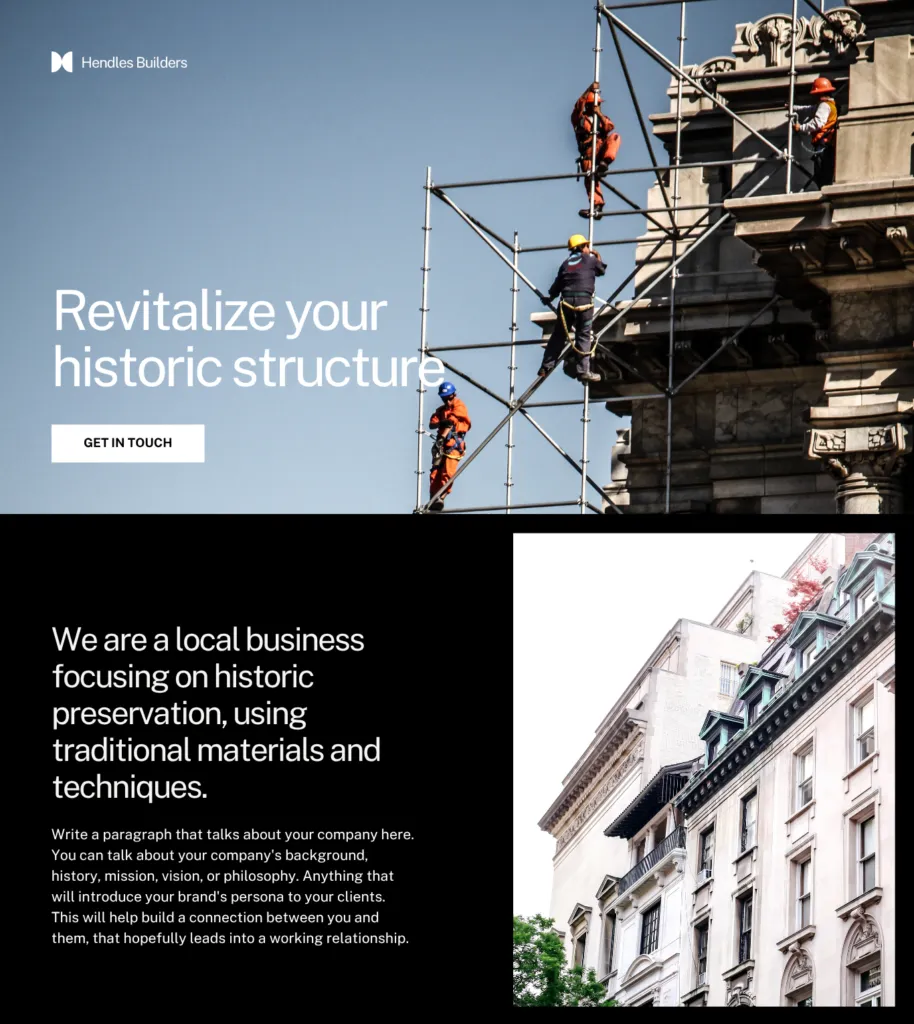
First, the basics. Canva Websites is a free website builder included on every plan. Importantly, you can publish to a free Canva subdomain (yoursite.my.canva.site) at no cost. Additionally, custom domain support starts at $14/year via Canva’s domain registrar — significantly cheaper than typical hosting setups.
Furthermore, the canva website review reveals genuine strengths. Notably, every Canva design can be published as a website in one click. For example, you can build a portfolio in Canva and publish it as a live URL within minutes. As a result, design-to-web workflow is the fastest in the industry.
However, Canva Websites has serious limitations. Specifically, there’s no blogging functionality, no e-commerce features, no contact forms with email integration, and limited SEO controls. Consequently, the platform works for landing pages and portfolios — not for content-heavy sites or online stores.
Additionally, the SEO restrictions matter. Importantly, you can set basic meta titles and descriptions, but you cannot customize URL structures, add schema markup, or optimize page speed. Therefore, Canva Websites is not a serious option for content marketers or SEO-focused businesses.
Feedback From Reddit
Moreover, common feedback from Reddit users on r/web_design confirms the same pattern. Notably, designers love Canva Websites for one-page sites but consistently warn against using it for full business sites. As a result, the verdict is clear: Canva Websites is a portfolio and landing page tool, not a Shopify or WordPress alternative.
For e-commerce specifically, the gap is enormous. For instance, an online store like Handiora needs product variants, checkout flows, inventory management, payment integrations, and order tracking — none of which Canva Websites provides. Therefore, real online stores still need Shopify, WooCommerce, or BigCommerce.
- Free websites on canva.site subdomain — no hosting needed
- Custom domain at $14/year — cheaper than most registrars
- One-click publish from any Canva design
- Mobile-responsive automatically
- No blog functionality — content sites should use WordPress
- No e-commerce — real stores need Shopify
- Limited SEO controls — basic meta only
- No contact forms with email integration
Honest take: The canva website review verdict is balanced. Specifically, use Canva Websites for portfolios, event pages, link-in-bio sites, and simple landing pages. However, for real businesses with products, blogs, or SEO needs, Shopify or WordPress remains essential. Therefore, judge it by your actual use case — not the marketing.
Need real e-commerce? Our complete Shopify Review 2026 covers the platform built for online stores — with payment, inventory, and checkout flows Canva Websites simply can’t match.
6. Canva Resume Review — Is It Good for CVs?
This canva resume review is genuinely useful for job seekers. Specifically, Canva offers 5,000+ professional resume templates across modern, minimal, creative, and corporate styles. Therefore, the visual quality of Canva resumes is among the best free options online.
Furthermore, the canva docs review reveals one related strength. Notably, Canva Docs (a Notion-style document tool) lets you write cover letters, project portfolios, and case studies that visually match your resume. As a result, your entire application package looks cohesive.
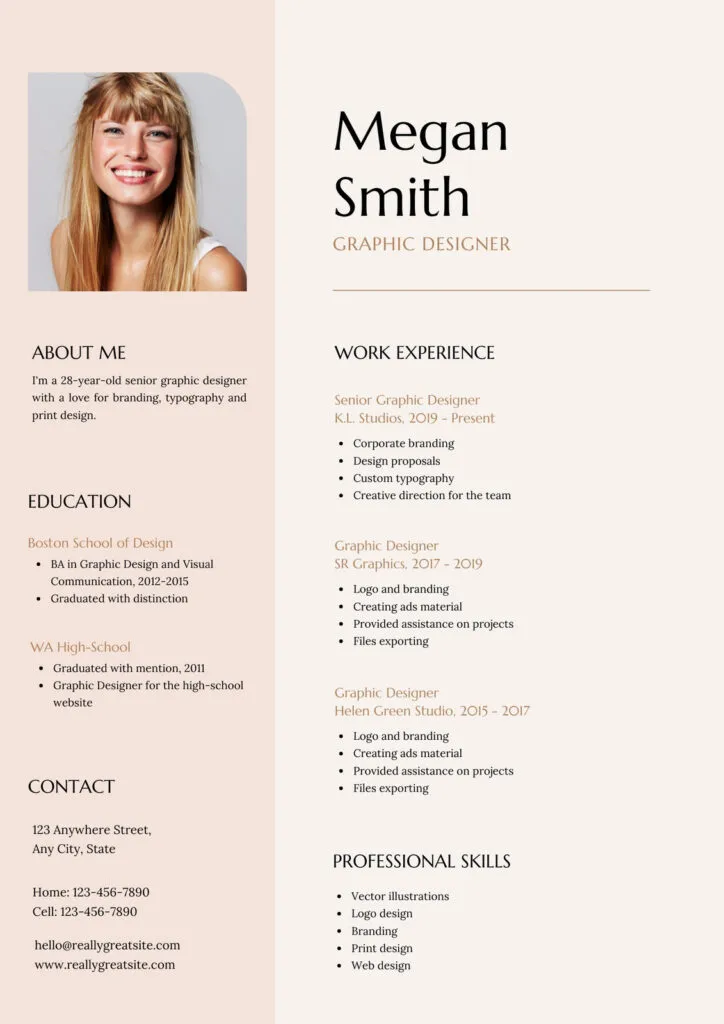
However, Canva resumes come with one critical warning. Importantly, many ATS (Applicant Tracking Systems) struggle to parse Canva’s design-heavy PDFs — meaning your resume may get rejected before a human sees it. Consequently, design isn’t enough; format matters too.
Therefore, the right approach is two-versions. Specifically, use Canva for visually impressive resumes when emailing directly to recruiters, and use a plain ATS-friendly version (Word or Google Docs format) for online application portals. As a result, you cover both scenarios.
For document-heavy work like notes, project plans, and team wikis, our Notion Review 2026 covers a dedicated alternative that beats Canva Docs for serious note-taking and knowledge management.
7. Canva Print Review — Photo Books, Prints & Quality
This print with canva review covers a service most people don’t know exists. Specifically, Canva Print delivers physical products — business cards, photo books, posters, t-shirts, mugs, and more — directly from any Canva design. Therefore, design-to-doorstep takes 5-10 business days.
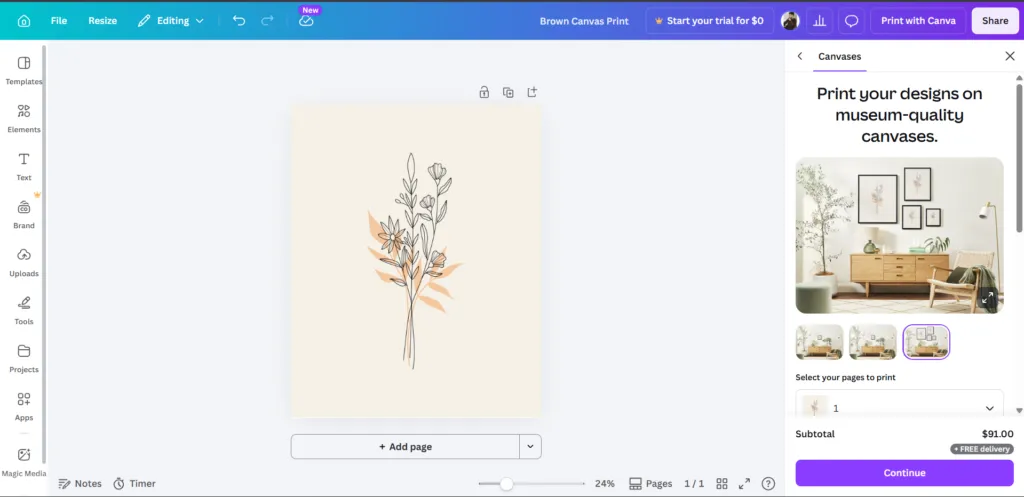
Furthermore, the canva photo book review highlights real value. Notably, hardcover photo books start at $34.99 and include 20 pages of full-color printing. As a result, Canva Print competes directly with Shutterfly, Vistaprint, and Snapfish at competitive prices.

However, print quality reviews are mixed. Based on aggregated feedback across G2, Capterra, and Reddit’s r/canva, the consensus is: paper quality is genuinely good, color accuracy is decent, and shipping is reliable. Consequently, the service works well for personal projects and small business orders.
However, for high-end branding work — luxury business cards, professional photography books, premium magazine prints — dedicated print services like Moo or Vistaprint Premium still produce noticeably better results. Therefore, judge by use case: Canva Print for everyday needs, premium services for premium clients.
- Photo Books — hardcover from $34.99, softcover from $19.99
- Business Cards — 50 cards from $19.99 with rounded corners option
- Posters & Prints — sizes from A4 to A0, matte or glossy finishes
- Apparel — t-shirts, hoodies, tote bags with custom designs
- Promotional — mugs, stickers, magnets, lanyards
- Shipping — 5-10 business days to most countries
8. Canva Pros and Cons — Honest Verdict
This canva review pros and cons section reflects aggregated user feedback from G2, Capterra, and Reddit. Therefore, the points below represent real-world consensus — not personal claims. Consequently, weigh each one against your specific design needs.
✅ PROS
- Easiest design tool in the industry — most users create their first design in under 10 minutes
- Genuinely useful free plan — 250,000+ templates, no watermarks, unlimited designs
- Massive template library — 1M+ templates on Pro across every category
- Magic Studio AI tools — text-to-image, magic resize, background remover, magic write
- Best mobile app in design tools — 4.9 stars on iOS, full feature parity with desktop
- Brand Kit on Pro — save logos, fonts, colors for one-click brand consistency
- Free for K-12 teachers, students, and verified nonprofits — major value-add
- Print-to-doorstep service — physical products delivered in 5-10 days
❌ CONS
- Limited typography control — professional designers find it restrictive
- No advanced layer management — cannot match Photoshop or Illustrator precision
- Website builder lacks blogging and e-commerce — not a Shopify or WordPress replacement
- Teams plan saw a 300%+ price increase in late 2024 — bad surprise for legacy users
- Limited SEO controls on Canva Websites — basic meta only, no schema or URL customization
- Canva-style design becoming over-recognized — risk of looking ‘templatey’
- Customer support is slow on free and Pro plans — priority access requires Enterprise
- File export limitations — no native CMYK on free plan, limited print-ready output
9. Who Should Use Canva in 2026?
Honestly, Canva is not the right tool for every designer in 2026 — and that’s worth being upfront about. Specifically, it wins decisively for beginners, small businesses, and content creators. However, professional designers consistently choose Figma or Adobe Creative Suite instead.
Furthermore, the right fit depends on three factors: design experience, output requirements, and budget. Therefore, the framework below helps you decide quickly.
✅ BEST FOR
- Small business owners creating social media content daily
- Freelancers and solopreneurs without design backgrounds
- Content creators producing thumbnails, Reels, and Stories at scale
- Students working on presentations, posters, and assignments
- Teachers building classroom resources (free Pro via Canva for Education)
- Nonprofits managing visual communications (free Pro via Canva for Nonprofits)
- Remote teams collaborating on quick design assets — though dedicated tools exist for serious workflows
❌ NOT FOR
- Professional graphic designers needing pixel-perfect control
- Branding agencies producing high-end client work
- E-commerce stores needing real website functionality — use Shopify instead
- Content marketers needing SEO-optimized websites — use WordPress instead
- Print production houses requiring CMYK precision and bleed controls
Building a remote team? Our guide to best tools for remote teams in 2026 covers collaboration platforms that pair perfectly with Canva for distributed design workflows.
10. Canva Review Reddit — What Real Users Say
Looking at canva review reddit threads across r/graphic_design, r/web_design, r/smallbusiness, r/canva, and r/entrepreneur, the 2026 sentiment is mixed-but-mostly-positive. Specifically, business owners and content creators love Canva for speed and accessibility. However, professional designers consistently express frustration with the limitations.
Furthermore, the canva pro review reddit threads reveal one consistent pattern. Notably, most subscribers say Pro ‘pays for itself’ within 2-3 months — primarily through Brand Kit and background remover usage. Therefore, the upgrade decision usually comes down to design frequency.
The recurring themes we saw in these discussions (paraphrased, not direct quotes):
- On r/smallbusiness, Canva is often described as the one design tool a whole non-designer team can actually use — the main argument for paying for Pro.
- Magic Studio tools, especially the background remover, are frequently praised as big time savers.
- Designers on r/graphic_design often note that Canva hits a wall when you need fine typography control.
- Canva Websites is seen as fine for small brochure sites, but not for running a blog.
- The 2024 Canva Teams price increase is a common complaint, with some small teams moving back to individual Pro accounts.
11. Final Verdict — Our Canva Review Rating
This canva com review and canva software review concludes with a 7-category rating based on aggregated user reviews, public feature data, and competitive analysis. Therefore, the scores below reflect documented strengths and weaknesses — not personal opinion.
| Category | Rating | Score |
| Ease of Use | ★★★★★ Best in design tool industry | 5.0 / 5 |
| Features | ★★★★½ Magic AI, Brand Kit, full suite | 4.5 / 5 |
| Pricing Fairness | ★★★★☆ Free plan is genuinely usable | 4.0 / 5 |
| Template Quality | ★★★★★ 1M+ templates, professional-grade | 5.0 / 5 |
| Integrations | ★★★★☆ 100+ apps, social schedulers | 4.0 / 5 |
| Customer Support | ★★★½☆ Slower on free/Pro plans | 3.5 / 5 |
| OVERALL | ★★★★½ Best design tool for non-designers | 4.5 / 5 |
Based on aggregated user reviews, pricing analysis, and feature comparison with competitors, Canva is still the best design tool in 2026 for beginners, small businesses, and content creators. Specifically, the combination of usability, template quality, and the genuinely useful free plan makes it the clear winner for non-designers.
However, professional designers, branding agencies, and serious e-commerce businesses should pair Canva with specialized tools. For example, use Canva for daily social content, Shopify for online stores, and Figma for product design. As a result, you get the best of every category.
Final Recommendation
Therefore, the final recommendation is straightforward. Start with Canva’s free plan today — it’s risk-free and genuinely powerful. Furthermore, upgrade to Canva Pro at $18/month only when you hit specific friction (Brand Kit, background remover, or Magic AI limits). Consequently, you’ll only pay when Canva is actually saving you real time and money.
| ✅ Best plan to start: Canva Free — genuinely powerful, no credit card required ✅ Best upgrade: Canva Pro ($18/mo or $144/year) — Brand Kit + Magic AI tools ✅ Best for teams: Canva Teams ($10/user/mo, 3 minimum) — shared brand assets + collaboration ✅ Best hidden value: Canva for Education / Nonprofits — full Pro features completely free |
Using Canva for email design? Pair it with the right email marketing platform. Our guide to the best free email marketing tools in 2026 covers Brevo, MailerLite, and more — all of which work beautifully with Canva-designed templates.
Building your full small business stack? Beyond design, our guide to the best CRM tools for small businesses in 2026 covers the customer management side that completes your toolkit.