| QUICK VERDICT — 4.3 / 5 Best for: Agencies, content-heavy businesses, and marketers who want every SEO tool in one place. Starting price: $139.95/month (SEO plan) — or $117.33/month billed annually. As of July 2026. Skip it if: You run one small site or blog. Cheaper tools like SE Ranking or Mangools cover most of what you’ll actually use. Semrush is still the most complete SEO platform on the market. However, the price only makes sense once SEO is genuinely driving revenue for you. |
If you’ve been searching for an honest Semrush review, here’s the short answer: it’s the most powerful SEO tool you can buy — and probably more tool than most small businesses need. This Semrush review breaks down the 2026 pricing (including the new SEO + AI Search plans), the features that actually matter, and what real users say. By the end of this Semrush review, you’ll know whether it fits your budget or whether a cheaper alternative makes more sense.
What Is Semrush?
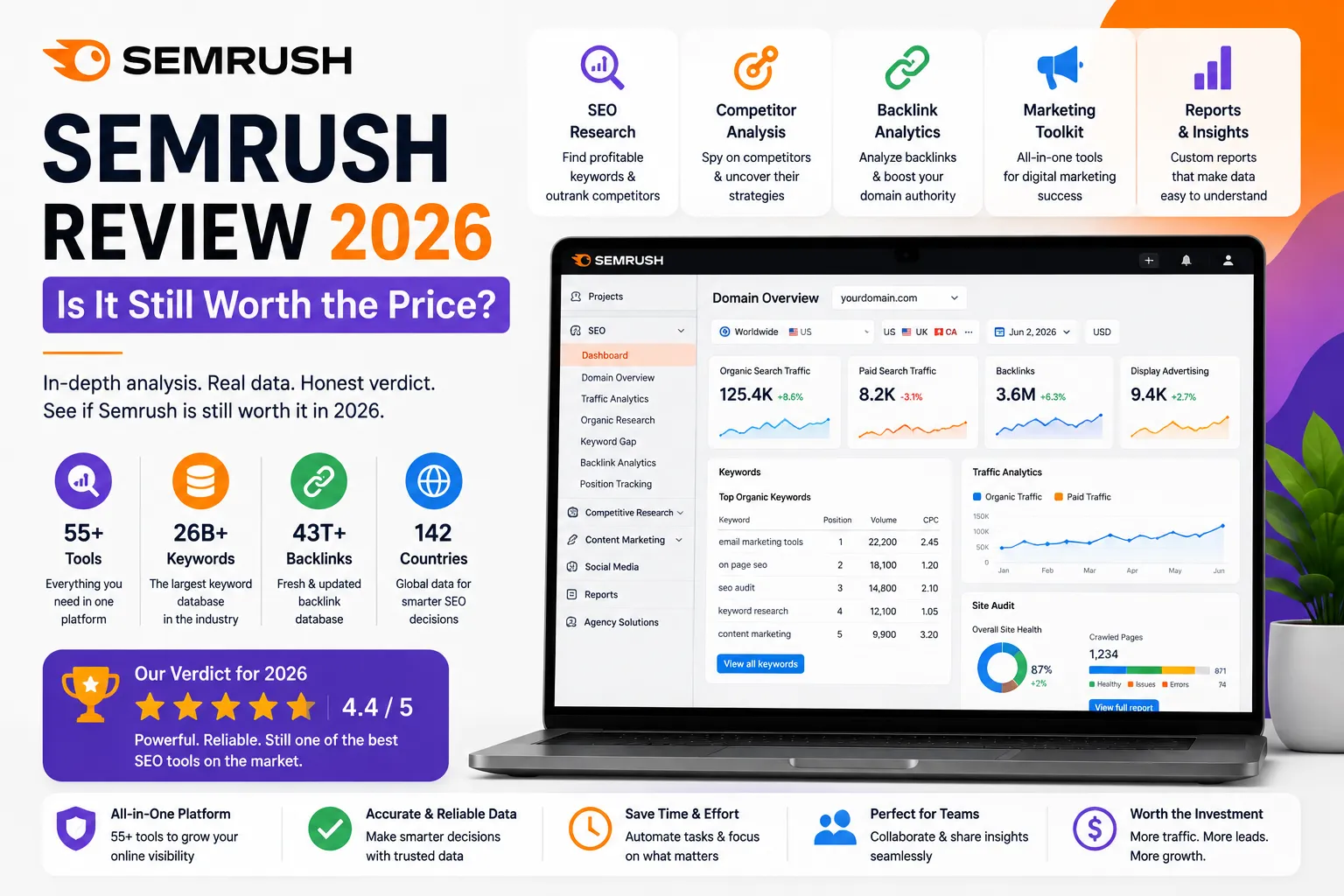
Semrush is an all-in-one digital marketing platform built around SEO. It covers keyword research, competitor analysis, site audits, rank tracking, backlink analysis, content optimization, and — new for this era — AI search visibility tracking.
The scale is the selling point. As of 2026, Semrush’s database includes over 26 billion keywords and more than 43 trillion backlinks — one of the largest datasets in the industry. Notably, the company was also acquired by Adobe, which is worth knowing if long-term product direction matters to you.
Any honest review of Semrush has to start with who it’s built for, though. Semrush increasingly targets agencies and larger marketing teams. That shift shows up clearly in the pricing — which we’ll get to in a moment.
Semrush Key Features — What You Actually Get
The verdict: keyword research and competitor analysis are best-in-class; everything else ranges from very good to “you’ll pay extra for it.”
Keyword Research
The Keyword Magic Tool is the feature Semrush is famous for, and G2 reviewers consistently rate it among the most user-friendly keyword research tools available. You type a seed keyword and get thousands of related terms with search volume, difficulty, intent, and cost-per-click data.
For example, small business owners use it to find low-competition questions their customers actually ask — the kind of keywords that are realistic to rank for without a huge site. In short, if keyword research is your main job, this tool alone carries a lot of the subscription’s value.
Site Audit & Technical SEO
The Site Audit crawls up to 100,000 pages per month on the entry SEO plan and flags technical issues — broken links, slow pages, missing meta tags — then prioritizes them by severity. Common feedback on G2 highlights this prioritization as a standout: it tells you what to fix first, not just what’s broken.
Competitor Analysis
This is where Semrush pulls ahead of cheaper tools. You can enter any competitor’s domain and see their top keywords, traffic estimates, backlink sources, and even their paid ad copy. Therefore, instead of guessing what works in your niche, you can reverse-engineer what’s already working for others.
AI Toolkit & AI Visibility
The newest addition — and the reason Semrush restructured its plans in late 2025. The AI Visibility Toolkit tracks how your brand appears in AI answers from ChatGPT, Google AI, Gemini, and Perplexity. Additionally, Semrush Copilot (an AI assistant) is included free on all paid plans.
Is AI visibility tracking worth paying for yet? For most small businesses, honestly, not yet. However, if your customers increasingly find products through AI chatbots, this is the most developed tool of its kind right now.
Local SEO & Review Management
Semrush’s Local toolkit (a paid add-on from $30/month per location, as of July 2026) handles listing management, map rank tracking, and review management — monitoring and responding to Google reviews from one dashboard. For brick-and-mortar businesses this is genuinely useful; for blogs and online-only stores, skip it.
Semrush Pricing 2026 — The Real Cost
The verdict: expect to pay $139.95–$299/month realistically — and watch the add-ons, because that’s where budgets quietly break.
As of July 2026, Semrush runs two plan families. The classic SEO plan covers the traditional SEO toolkit. Meanwhile, the SEO + AI Search plans — Starter, Pro+, and Advanced — bundle the SEO tools with the AI Visibility Toolkit at a combined discount.
| Plan | Monthly Price | Annual (per month) | Best For |
|---|---|---|---|
| Free | $0 | $0 | Testing the interface (10 requests/day) |
| SEO | $139.95 | $117.33 | Freelancers, small businesses |
| Starter (SEO + AI Search) | $199 | — | SEO + AI visibility bundled |
| Pro+ (SEO + AI Search) | $299 | — | Growing brands scaling SEO + AI search |
| Advanced (SEO + AI Search) | $549 | — | Teams needing API access and automation |
The SEO plan covers 5 websites, 500 tracked keywords daily, and 10,000 results per report — enough for most small businesses. However, three costs catch people off guard:
- Extra users cost around $80/month each. Every plan includes just one seat, so a three-person team on Pro+ pays closer to $460/month, not $299.
- Add-ons stack up. AI Visibility runs $99/month, the Content Toolkit $60/month, Local SEO from $30/month per location — all as of July 2026.
- The free trial auto-converts. Semrush offers a 7-day free trial and a 7-day money-back guarantee, but the trial requires a card and bills automatically. Set a reminder.
💡 Key insight: If you’d buy both the SEO plan ($139.95) and AI Visibility ($99) separately, the Starter bundle at $199 saves you about $40/month. Otherwise, the classic SEO plan is the sensible entry point.
Semrush Pros and Cons
What users love: Semrush holds a 4.4/5 rating on G2 from roughly 3,900+ reviews and 4.6/5 on Capterra from 2,200+ reviews, as of July 2026. The consistent praise: everything lives in one platform. Keyword research, audits, competitor data, content tools, reporting — no juggling five subscriptions.
Reviewers also single out the keyword database quality, the site audit’s clear prioritization, and position tracking that agencies use for client reporting.
What users complain about: Price, price, and price. “Expensive” is the single most common tag in G2’s review analysis of Semrush, appearing in over 500 reviews. Additionally, the interface has a real learning curve — ease of use is consistently Semrush’s lowest-rated dimension on review platforms.
One more honest flag: Semrush’s Trustpilot rating sits far below its G2 score, driven almost entirely by billing and cancellation disputes. The product earns its ratings; the subscription management doesn’t. Read the cancellation terms before you enter a card.
Who Should (and Shouldn’t) Use Semrush
Semrush makes sense if: you’re an agency with client retainers, a content-driven business publishing regularly, or a marketing team that wants one SEO platform instead of four separate tools. At that scale, the consolidation genuinely saves money and time.
Skip it if: you run one small website or blog and mostly need keyword ideas plus rank tracking. In that case, SE Ranking or Mangools can cover much of what you’ll actually use at a lower cost. If you want to see where SE Ranking saves money — and where it still falls behind Semrush — read our SE Ranking Review 2026.
Additionally, pair whichever SEO tool you choose with a solid writing workflow — our Grammarly Review 2026 covers the editing side of content that ranks.
What Reddit Users Say About Semrush
Reddit is where the unfiltered opinions live. Here’s the recurring sentiment across SEO communities:
- Common sentiment on r/SEO: the newer pricing feels aimed at agencies and enterprise buyers, and solo site owners feel increasingly priced out.
- Common sentiment on r/SEO: Semrush is powerful but not essential — many professionals mix cheaper specialized tools with free Google tools instead.
- Common sentiment on r/bigseo: for agencies billing multiple clients, the all-in-one convenience and client reporting justify the cost.
- Common sentiment on r/juststart: freelancers and niche site builders lean toward Mangools or Ubersuggest plus Google Search Console until revenue justifies upgrading.
- Common sentiment on r/SEO: keyword volumes and backlink counts differ between tools, so treat Semrush’s numbers as directional rather than absolute.
Semrush Alternatives
Ahrefs is the closest direct rival — slightly ahead on backlink data, slightly behind on breadth. SE Ranking (4.7/5 on G2 as of July 2026) is the best budget all-in-one, and Mangools is the friendliest entry point for complete beginners. We compared all of these — plus the best free options — in our full guide to the best Semrush alternatives in 2026.
For instance, if you’re running an online store, your SEO tool should complement your platform — our Shopify Review 2026 and WooCommerce Review 2026 both cover the built-in SEO capabilities of each platform.
Semrush Review — FAQ
Is Semrush worth it in 2026?
Yes — if SEO drives real revenue for your business. For agencies and content teams, the all-in-one value is hard to beat. For a single small site, cheaper alternatives deliver better value per dollar.
Does Semrush have a free plan?
Yes, but it’s limited: 10 analytics requests per day, one project, and 10 tracked keywords. It’s enough to test the interface, not enough for real ongoing SEO work.
How is the Semrush affiliate program?
Semrush runs its affiliate program through the Impact network, paying commissions on trials and subscriptions. Based on published program details, it’s considered one of the stronger programs in the SEO software space.
Semrush or Ahrefs — which is better?
Ahrefs edges ahead for backlink analysis; Semrush wins on overall breadth, PPC data, and content tools. Most professionals say you can’t go wrong with either — the workflow you prefer matters more than the feature lists.